
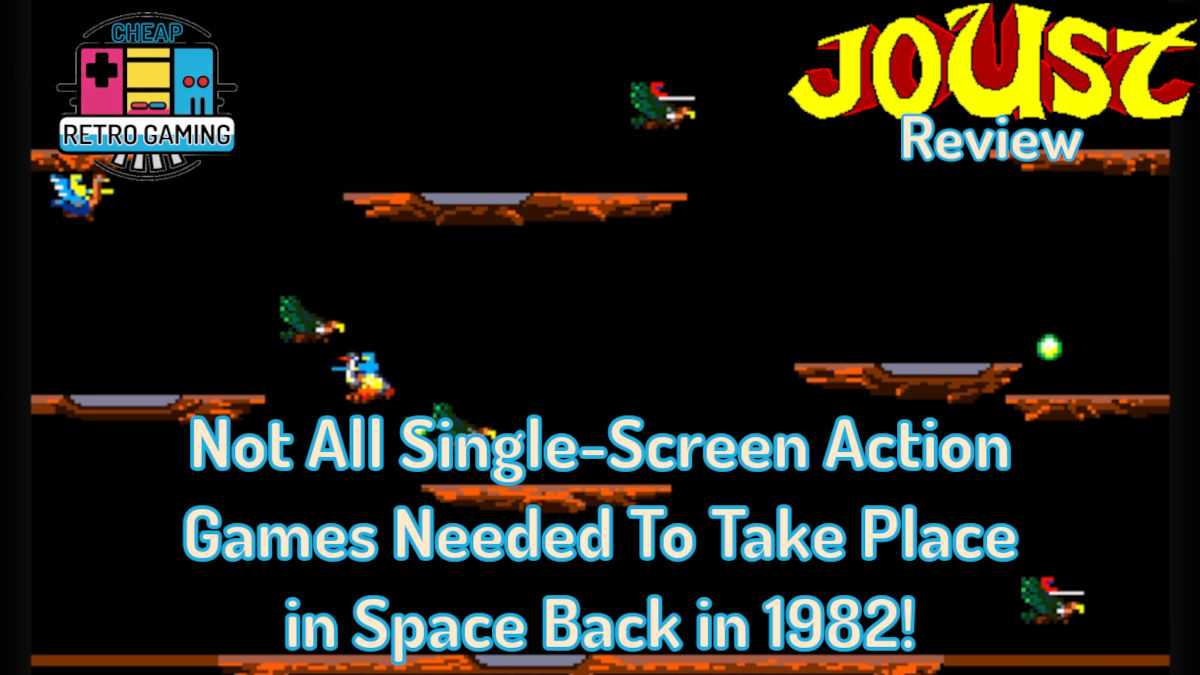
In the 1980’s, there were a ton of games that influenced the design of latter titles. The great success of Pac-Man (NES Review) compelled other game developers to produce other maze games. While Hang-On and Space Harrier (TG-16 Review) both popularized sprite scaling technology in arcade games with characters moving toward the center of the screen in a way that mimicked a 3D effect. Near the beginning of the 1980’s, there were also a wide assortment of single-screen action games. Many of these featured a perhaps overused space theme. But one title from 1982 turned away from that theme with players riding birds, Joust.
Gameplay

You control a character riding an ostrich (if you’re Player 1) while holding a lance in front of you. With the press of a button, you can make your bird flap its wings to hop around. Doing so repeatedly allows it to fly up off the ground and around the screen with a wide range of moment. However, if you stop pressing the flap button, you’ll fall to the ground. The goal is to hit the enemies on the screen with your lance by being higher than them in the air.
After just one hit, they’ll fall off their bird and an egg will start falling toward the ground. Pick it up to earn bonus points and keep the fallen foe from returning. Once all your opponents have been defeated, you move on to the next stage. If you take too long, a pterodactyl will shriek and start flying around the screen, trying to take you out.
The concept is simple, and easy to learn, but the controls have some interesting dynamics that I didn’t initially expect. There’s a lot of nuances with how inertia works in the game, and the speed at which you hit the flap button. You also have to take gravity into consideration. As it sometimes makes more sense to float down to the ground to avoid an attack instead of attempting to fly upward quickly.

For the stage layouts, they feature multiple ledges that you can land on, and near the beginning of the game, two bridges at the bottom-right and left as well. The arrangement of these objects change as you progress through the game. For example, at the start of stage 3, the bridges are burned down, exposing a dangerous new area that needs to be avoided.
In regard to the gameplay as a whole, another concept I was surprised by was just how horizontal the game feels. Of course, the vertical height of your character is extremely important for you to defeat your adversaries, but they tend to fly across the screen from one side to the other. While they move up or down based on where you’re located at times, it isn’t as pronounced as their horizontally movement. This sensation is compounded by the wide platforms that are located around the screen. They keep you from being able to fly upward as much as in other games that feature this style of gameplay, such as Nintendo’s Balloon Fight.
Music and Sound Effects

Like other titles from the early 1980’s, there is no music during normal gameplay. Despite its absence, I don’t think it is a massive loss to the sound design of Joust. There are many sound effects in the game, such as flapping wings, lances clanging against each other, screeching noises as you stop on the ground, and more. This was one of the first games I’ve played where I didn’t miss the lack of music. It reminds me of Atari’s Destroyer (Review) in that sense. The sound effects more than made up for their absence!
Graphics

Joust’s graphics also feature a similar contrast. The majority of the screen is a pure black, which may lead some players to think that the game will be boring at first glance. The sprites for your bird and the other riders aren’t too large either.
There’s more to it than that, though. The game’s animation is high quality, with the sound effects being very effective at emphasizing what is shown on screen. The flapping of the birds’ wings, fire burning down the bridges on stage 3, and the color spectrum on your character before moving after a death are just a few examples
Where Joust lacks in large sprites, it makes up for it in smooth, fast movements of the characters. There’re also more foes to contend with than I would have initially thought. This is the case after just a few stages. Things become hectic rather quickly because so many enemies are trying to smash into you on a regular basis.
Again, this sense of tension is further heightened by the game’s quality sound effects that complement the graphics.
Final Thoughts

That’s one of the aspects that makes Joust stand out. The synergistic nature of the game’s parts help it to be more enjoyable than what one may expect. Such as the game’s physics and control that are strongly related to each other. Then there’s the enemy AI that is constantly trying to attack you, and the need for you to be aggressive yourself. If you’re not, then the pterodactyl will come and take you out.
All these elements of stress,
- Such as the constant barrage of enemies,
- The sound effects that accompany them,
- And the built-in time limit,
Means that Joust has a strong sense of frantic tension that makes it addictive to play repeatedly. As I was challenged by it, I didn’t care that I was only able to survive for a few minutes before being faced with a game over screen. I could see myself improving, and becoming more adept at the game’s mechanics.
That, along with a fun two-player mode that could be played cooperatively or competitively, meant that I had a lot of fun with Joust, and I can see why it was popular back in 1982.
It easily earns a Positive rating from me!
Review Overview

Summary: Another influential arcade game from the 1980’s that may initially appear boring. Yet, its different parts complement each other well and the way the tension builds as you play is impressive!
Title: Joust (Wikipedia)
Genre: Single-screen Action
Year Released: 1982
Developer: Williams Electronics (I tend to refer to them as “Williams”).
Available On: Joust is available on a myriad of game compilations including Midway Arcade Origins for the Xbox 360 and PlayStation 3. It was also released on the NES, Gameboy, GBA, N64, Xbox, PlayStation 2, Dreamcast, along with many other systems.
Price Paid: $0.16, or $4.99 for the Midway Arcade Origins collection.
Remember, we can have different opinions about the games we play. If you like something more (or less) than I do, both of our perspectives are valid. Please see my Review Rating Scale to know more of how I rate games.
Leave a Reply