
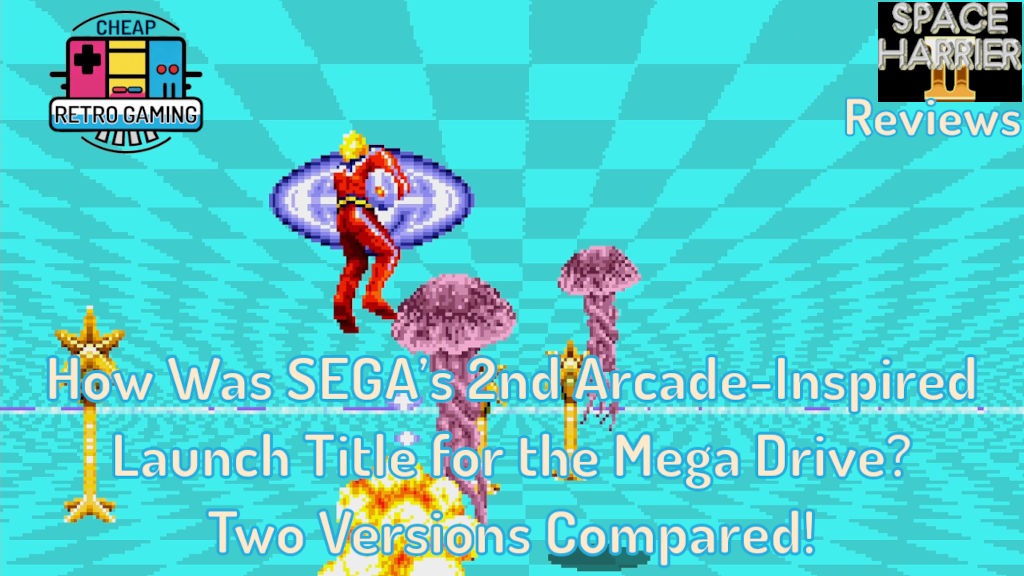
When considering SEGA’s early titles for the Mega Drive and Genesis, it’s clear that one of their goals was to make home console releases as similar to their arcade counterparts as possible. Such a notion had been successfully accomplished before, but primarily for titles that were from the mid-1980’s and earlier. But SEGA was well known for their arcade titles that featured Super Scaler technology. So, what better way to introduce the world to their latest new home console than to develop sequels to their arcade games? That’s what they did with at least a couple of launch titles, one being Space Harrier II.
Gameplay

Sadly, after starting it up, the game began in a less than impressive manner. The title screen was dominated by a black background, similar to what we’ve seen in many 8-bit titles on the NES. The way the letters of “Space Harrier” flew from the background to the foreground was choppy, and the flipping animation of the “II” was far from smooth. Once I was actually playing it, things continued to get worse. While your main character was larger than in many 8-bit titles, and the ground moved smoothly, sprites scaled in size in a very jerky fashion. And to add insult to that, I thought the explosions of defeated enemies sounded like farts!
For someone who used to like this game a lot as a kid, you can imagine my great disappointment with all this! I decided to put the game down, and just wait.
After a couple of days, I tried it again, with greater success. The first stage was a forested area, not unlike what we found in the original game. I noticed that it routinely had four to six trees and/or shrubs on the screen at once without using background tiles or having excessive flicker. The mix of the fantasy and sci-fi art style that I equate with the series was readily apparent. Some of the early enemies were jets that fired ring-shaped bullets at me. Near the end of the level, I faced a green dragon that immediately reminded me of the first game. Surprisingly, this was not the boss. Upon reflection, I now consider this moment to be a great inside joke for players. It’s like the developers were saying, “This isn’t Space Harrier 1, it has its own identity!”
Stage two featured some ugly green heads that attempted to rotate around the screen as they fired at me. The level also included the first impenetrable obstacles that I couldn’t destroy. As I continued to play the game, I grew to like it again and became accustomed to how the sprites moved around the screen. I also noticed how the developers tried to keep gameplay mechanics from getting stale as I progressed. This was most pronounced at Copper Hill, which combined navigating through groups of columns while also destroying enemies like headless armors. I couldn’t just repeatedly rotate around the screen to survive.
In regard to the game’s bonus level, you fly on a hovercraft that has guns and use it to destroy clams and headless armors for bonus points. This was a little less compelling than the first game; the gameplay of the stage wasn’t drastically different than normal ones. At least it’s present. If it wasn’t there then its absence would have been more noticeable.
Like the first game, there isn’t any way of earning power ups. It’s just you and the game as you try to defeat all 13 levels in succession. That makes it significantly shorter than the original. There’s also no way to continue. At least you can choose your starting level at the beginning of the game so you can practice latter stages as needed. Once you beat all 12, you take on the game’s final challenge of a boss rush.
Beyond the level select, you can press A at the title screen to change your options. Some include reversing the directional inputs on the D-pad and turning on turbo fire. The latter allows one to fire about five shots from your gun before having to wait to fire again. The game also has a music selection screen and difficulty option that changes the number of lives you begin with.
Graphics

Like I spoke of earlier, I was stunned at just how choppy Space Harrier II was when I played it again for this review. I was immediately disappointed by it!
However, after taking a couple of days away from it, I was able to appreciate some of its graphical aspects. For instance, the sprites were significantly larger than on competing 8-bit systems. Additionally, the ground scrolled extremely smoothly (at least when there weren’t any sprites moving on it). Despite the choppy sprite scaling, at least I was pleased with the number of objects on screen. A lot of the time there were 4-5 enemies flying around at once, along with 2-3 hazards as well. This was especially the case in the second half of the game.
A couple of other aspects I enjoyed include the variety of sprites as I shot my way through the game. Even in the last third there were new enemies and bosses being introduced. Some of these were a bit boring (such as the head that split apart), but I liked most of the designs enough to be glad about their inclusion. I appreciated the callbacks to the first game, especially. The other part I liked a lot was how the camera would pan after being hit and your harrier would fall down. It would move in a smooth manner that impacted the perspective of everything else on the screen. This was quite noticeable with the enemy’s bullets. They’d move in a realistic manner as your character fell down. Likewise, the 3D space you could move around in this game seemed wider, than in the original Space Harrier. When I was flying near the top of the screen the hazards seemed taller than at first glance. These two sets of effects in relation to the perspective were my favorite things about the game visually. They helped made it stand out from what was available on earlier consoles.
All things considered, I wasn’t impressed with the game’s graphics today, although I eventually became used to the poor scaling. I liked the art design at times, along with the perspective effects, though.
Music and Sound Effects

To put it bluntly, I wasn’t blown away by the title’s music and sound effects. I’ve already touched on the latter, and how I didn’t like them at all! Like I said, the explosions sounded like farts! Eventually I became used to it, and stopped noticing it as much. There were times when my kids and I would still laugh at it, though. Some of the other sound effects were fine, such as the thunder when bosses appeared. To me, the best part of this aspect were the game’s digitized voices. The “Get Ready!” was clear and impressive.
Turning to the music, the understated title theme with its limited number of notes was slightly interesting to me (Motion). Not that I stood and listened to it much, but I thought it was an intriguing choice of how to start the game.
Reflecting on the game’s music as a whole, I am OK with it. It has a different feel than its predecessor, which may disappoint some players. I liked some of the boss themes a good deal. Harrier Saga was an entertaining, upbeat track that used the SEGA Genesis’ sound chip well. It was great at drawing the player into the game at the beginning. Unfortunately, most of the music isn’t memorable enough for me to want to listen to it by itself. The piece that played at the beginning of each stage was probably what rubbed me the wrong way, as well. It was like a calm before the storm, but it heightened my sense of ambivalence toward the soundtrack.
Overall, the audio experience was fine.
In Comparison to SEGA’s Other Rail Shooters

Considering its time of release, the first game to compare with Space Harrier II is SEGA’s own Super Thunder Blade (Review). Both were launch titles for the SEGA Genesis/Mega Drive in multiple territories, Rail Shooters, and console sequels to established arcade titles.
Many of my readers will know that I did not like Super Thunder Blade at all; I gave it a Negative rating, and it is one of my most poorly reviewed titles on the site. Yet, the sprites in it looked pretty good, and some of the music was enjoyable. The choppy scaling was bad and it generally had a slow speed as well, which didn’t help with the game’s graphics or gameplay. What killed it for me was stage 2, with its caves you have to fly through repeatedly to reach the boss. The hit detection was especially dicey at that point, so I never became proficient at getting through the stage efficiently. It was a huge difficulty spike compared to the opening level. Since the title only had four stages, it also felt like a rip-off for a full-priced game.
On the other hand, Space Harrier II featured a rather boring title screen upon start up, but Harrier Saga was a great way to start the game from a musical perspective. Moreover, its level select option was a surprising inclusion at the beginning, along with the fake out with the green dragon near the end of stage one. While the title is very choppy, at least it moves at a fast clip, and features three times as many stages. Additionally, the difficulty doesn’t ramp up much until reaching stages four or five. I think the game becomes interesting with Copper Hill and latter.
The other title worth mentioning is the original Space Harrier, while it never officially came to the system on a regular cartridge, it was released on the NEC Turbografx-16 (TG-16). What I find most telling about this is that Space Harrier II came out on October 29, 1988 for the SEGA Mega Drive in Japan. Two months later, the original game was sold on NEC’s PC Engine on December 9th as well. So, in a sense, the two titles were contemporaries of each other!
I surprised myself by enjoying the original Space Harrier so much on the TG-16 when I reviewed it near the beginning of this year. Despite it running on less powerful hardware, the game blew me away! It was fast paced, smooth, and the music was catchy. I still enjoy playing it to this day. Space Harrier II did edge it out in a couple of areas. The voice samples are notably clearer and the sprites are larger. While the port of the original game had a scrolling background at the horizon and perspective effects after dying, those aspects are more pronounced and enjoyable to me in the SEGA Genesis release.
Considering all three titles, I’d rank them as follows,
- Space Harrier (TG-16 Version)
- Space Harrier II
- Super Thunder Blade
Final Thoughts

Looking at the ranking above, I can say that I ended up liking Space Harrier II. It had a similar pick-up-and-play quality that I appreciated from the original game. The level design, art style, and music were different enough to make it feel like its own distinct game from Space Harrier as well. I even came to like how the rapid fire option had a forced break in shots; it made me think about when to fire and when to let go of the button in preparation for an upcoming wave of enemies.
Not that I consider it better than original, but I definitely enjoyed it more than Super Thunder Blade. I can see why I liked this game when I was younger.
Since parts of it still hold up, in a flawed sort of way, I’m giving it a Mixed rating. But that isn’t the end of what I think about Space Harrier II. Read on to see how it compares on the SEGA Genesis Mini 2 with its improved scaling capabilities!
Review Overview

Summary: Despite its extremely choppy scrolling, Space Harrier II still offers some quick Rail Shooter fun in its art design, stage variety, and music at points. Not amazing, but I grew to enjoy it.
Title: Space Harrier II (Price Charting)
Genre: Rail Shooter
Year Released: 1988 in Japan, and 1989 in the USA
Developer: SEGA
Available On: SEGA Genesis, and the SEGA Genesis Mini 1 & 2 (Wikipedia). The Mini 1 has the original version of the game, while the Mini 2 contains a remade version along with Space Harrier 1.
Price Paid: $3.10 for the original version and $2.07 for the remake. In total, I paid $130 for the Japanese SEGA Mega Drive Mini 1 and $123.93 for the USA edition of the SEGA Genesis Mini 2.
Remember, we can have different opinions about the games we play. If you like something more (or less) than I do, both of our perspectives are valid. Please see my Review Rating Scale to know more of how I rate games.
Review of Space Harrier II on the SEGA Genesis Mini 2
Over three decades after the release of Space Harrier II on the SEGA Mega Drive and Genesis, a new version of the game was featured on a mini console in 2022. It had previously been included on the SEGA Genesis Mini 1, but this time, the developers wanted to do something special. They developed a unique version of the game that had enhanced scaling capabilities that weren’t possible on the original hardware. With its inclusion on the SEGA Genesis Mini 2, it sought to answer the question, “What would happen if the SEGA Mega Drive was capable of sprite scaling?”
Gameplay

Once I started it, I noticed some improvements immediately! Even at the title screen, the way the words, “Space Harrier” came forward on the screen was incredibly smooth. The “II” even flipped toward the front of the screen in a slightly different manner. Despite the largely black background, things were boding well! Another nice addition was the options menu being readily visible after hitting the Start button. Of course, the same choices were still available, such as reversed directional controls and rapid fire.
After playing the game proper, the speed of the scrolling was great, along with the sprite scaling. Moving my character around was as easy as expected, with the ring bullets coming at me very smoothly. In fact, I was so shocked by how the first few looked that I just stood still and got hit by them! I kind of laughed at myself, and continued to play the game.
As in the original version, you just press a button to fire your gun and the D-pad to move around. In relation to these controls, one aspect that was different was that your rate of fire felt a lot faster. There’s still a short pause after each salvo of bullets, but the delay didn’t seem to be as great. As such, I was able to defeat some bosses, such as the dragon at the end of stage three, about 50% quicker than expected. The same could be said for the medusa boss. I’m unsure if the number of hits needed to defeat them had been adjusted, if I was better at aiming, or if it was due to the increased rate of fire.

Early on in my first gameplay session I noticed another surprising aspect. That being the modified hit detection from the original game. For example, in the prior version, I was able to be running along the ground on the right side, wait for the first wave of jets to come at me, and fire my gun and hit them. This was also possible on the left side. That didn’t work here, and I tried it multiple times. I had to be flying a little off the ground to hit them in this one. Perhaps the hit detection is more precise than before? Likewise, the aim assist, or homing, of my shots had been improved. On stage two I could easily hit the green heads that flew from one side of the screen to the other near the horizon. I usually missed one or two, but I hit all of them regularly here.
Because of these changes, I think this version of Space Harrier II is slightly easier than before. Similarly, I view it as a “reimagined” edition, since your rate of fire and hit detection are so different.
Graphics

Unfortunately, not every change was for the better. The prevalence of flicker is far more pronounced! In the original version, sprite flicker was kept to a minimum. This was so much so that I praised that aspect in my review above. However, here it really stands out. The first time it hampered my enjoyment was at the fight with the green dragon. At least the problem comes and goes; it isn’t constant. Yet when it’s really bad, it can be overbearing. One of the worst examples is when taking on the second boss with its red orbs flying around. There, large portions of the screen would be invisible throughout the battle. Speaking of which, some details are lost in this version as well. I’ve always thought that the face changing with the second boss was kind of interesting. Sadly, that’s not present in this one. The head is there, but the face with the eyes and mouth are absent.
Another common instance of glitching was after I smashed into the pillars at Copper Hill or elsewhere. When I did so, they would look like a collection of sprites instead of whole ones. What made this odder was that the group of columns far off in the distance would flicker or flash behind them, too. It was odd to experience, and made it feel like the game was breaking.
At least moments with the game’s good art design were still present. Sometimes they took a back seat to the sprite flicker, though. I wish the smoothness was a little bit less, so that the graphical glitches could be reduced. That’s a hypothetical idea I have about it, anyway. I don’t really know if there was a connection between the two.
Music and Sound Effects

On the other hand, one thing I did know was that the audio quality was inferior to the original. In fact, I think this is the part that suffered the most. In general, the music seemed to be at a lower volume or fidelity compared the cartridge version. So much so that sound balancing even felt out of whack! The sound effects of your gun shots and enemy explosions drowned out the soundtrack on a regular basis. I even tried to verify this by playing the Mini 2 version and then playing the original back-to-back. The difference in volume levels was stark. This, along with the lower quality music, meant that the compositions were even less engaging now. Which is a shame, because I’ve grown to like some of the boss themes, in addition to Harrier Saga.
Moreover, the voice samples for the announcer were obviously scratchier. Previously, they were clearly superior to what was found on the TG-16 version of Space Harrier. That is not the case here. They are probably still better than on that one, but not as much.
At least the music test was still present in the options menu. That way you can listen to the best tracks without the sound effects blowing it away.
Final Thoughts

Considering that Space Harrier II’s choppy scrolling was one of the aspects that I disliked the most about it, I have to give credit to M2 for making this version and having it run so smoothly. It truly is impressive! While I didn’t like the increased flicker, I could work around it most of the time. I did find a de-flicker mode available at SegaRetro.org, but I haven’t tried it as of the posting of this review. To do it, hold down right on the D-pad while choosing Options. I also appreciated the more precise hit detection, although I’m not too fond of the rapid fire being adjusted. I felt like that was part of the prior version’s gameplay style. It was sad about the music and sound effect quality being hampered. I’d be nice to know why that had to be done.
In regard to my overall rating of this version, I knew I viewed it as superior to the original release, but I wasn’t sure by how much. At one point it just clicked in my head, though. I was shooting down all the green head enemies from stage two, and I marveled that the control was smooth, the hit detection was precise, the assisted aiming was better, and the sprite scaling was great. It was at that point that I decided to give this version a Positive rating.
The audio problems were still present, and I don’t like the adjustments to the rapid fire or the flicker, but I felt like I was having a more fun time. That was what mattered the most.
Review Overview

Summary: It’s a shame that this isn’t the ultimate version of Space Harrier II, but the improved sprite scaling is impressive and the more precise hit detection is appreciated. The lower quality music and sound effects are a pain, along with the flickering, but I still found it to be more enjoyable than the original version.
Title: Space Harrier II (Price Charting link for the original game)
Genre: Rail Shooter
Year Released: This redone version was released in 2022 on the SEGA Genesis Mini 2.
Developer: SEGA
Available On: The SEGA Genesis Mini 2 (Wikipedia).
Price Paid: $2.07 for the remake. In total, I paid $123.93 for the USA edition of the SEGA Genesis Mini 2.
Remember, we can have different opinions about the games we play. If you like something more (or less) than I do, both of our perspectives are valid. Please see my Review Rating Scale to know more of how I rate games.
Leave a Reply