
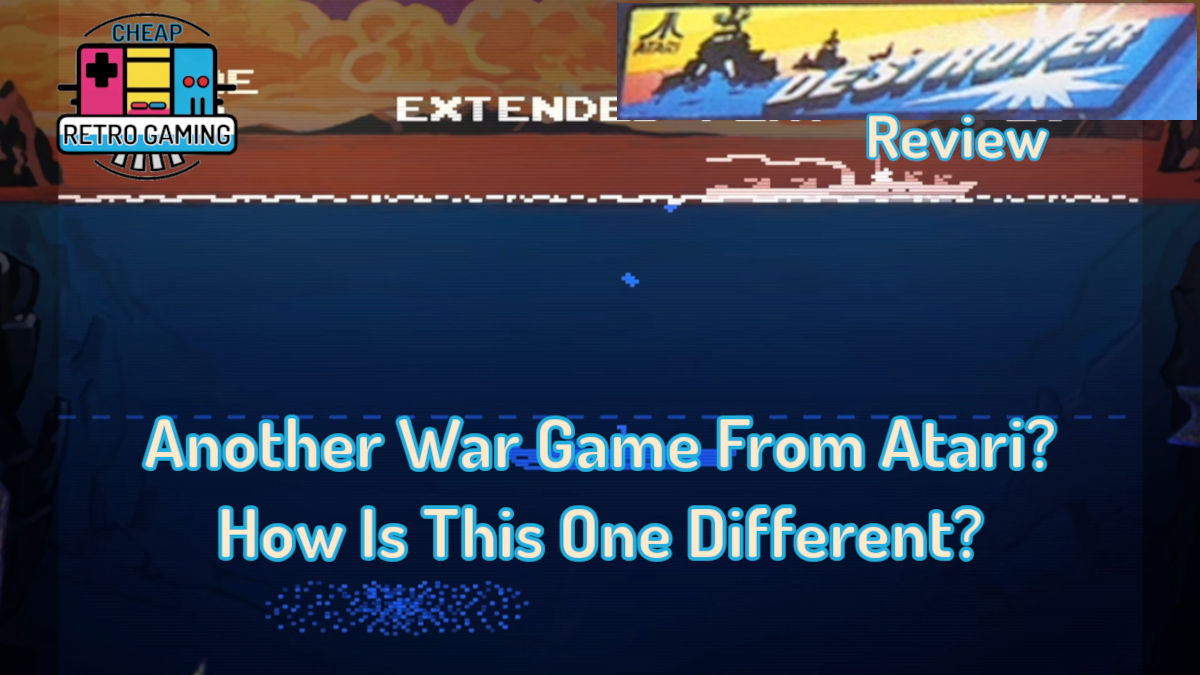
Over the years, one thing I’ve forgotten about early Atari titles is just how many of them are focused on war! I’ve already reviewed a couple that have that share that theme, and that’s after exploring just five games from the Atari 50 collection. This will be my sixth review from the developer, and my third one that takes place during war time. It is an arcade game from 1977, and is simply titled “Destroyer.”
Gameplay

As we learn from the game’s title, you control a destroyer out at sea that is near a series of islands. Of course, destroyers have all sorts of weapons, but in this game, you’re only able to use your depth charges. You press a button to throw one overboard with the hopes of it hitting a sub or other vessel down in the ocean. You can drop multiple ones at a time, but after you launch off five or six, you have to wait a few seconds before doing so again.
With your ship being at the top 20% of the screen, you’re tasked with destroying as many enemy vessels deep in the ocean as you can. Of course, the primary goal is simply to earn more points. Along with dropping your depth charges, you also need to move a horizontal bar up or down at the same time. The latter dictates at which depth your weapons will explode. Having good timing with these two actions is necessary to destroy the different subs. You can also hold down the right trigger button to increase the speed of your destroyer at it goes across the screen.
Managing these three different aspects of your destroyer’s control is compelling. However, I found the increasing of your speed to not be very useful. I didn’t utilize it very much, and when I did, my score tended to suffer. Perhaps I just needed more practice.
The biggest surprise about the gameplay is that none of your adversaries are shooting at you. So, there’s no way to die in the game! Also lacking is your armament of weapons. You can’t use any of your cannons, even though you can see them on your vessel’s sprite.
While the above may sound limiting and disappointing, I want to stress that Destroyer is actually a somewhat addictive game. It has a quick gameplay loop, with play time usually being about 125 seconds. You can also earn an extended play session of 30 more seconds if you reach the necessary score threshold indicated on the screen.
Additional dip switch settings allow for changes in the game length and also the required score to earn extended time. Unfortunately, these options are mainly useful for arcade operators back in the day. There’s none that change the game’s difficulty or modify the gameplay in any meaningful way.
Graphics

For 1977, I have to say that Destroyer’s graphics are really impressive! The cannons on your vessel are easily identifiable, and the enemy ships are similarly well defined. Despite the explosions not having many frames of animation, they’re satisfying to look at when they blow up.
The most striking visuals from Destroyer don’t come from the sprites, though. Instead, it’s the background of where your battle is taking place and the artwork around the screen that are the best things about the game visually. Near the top of this review, I made a point of referring to some islands. I did this because the game’s background gives the impression that it is taking place in the Pacific Theater of World War II. Moreover, the sky is cloudy, with a red tint to the horizon, reminding me of a setting sun. While the background isn’t animated, it has a strong sense of style and tone that I appreciate. I’d even say that it’s the first time that I’ve been truly impressed by an arcade game’s background since Taito’s Space Invaders (Review).
Past the game’s monitor, there’s also artwork that wraps around it. These extend the game’s clouds and islands to the right and left, along with a large mine or depth charge that’s to the bottom-left of the game’s screen. A search light can also be seen at the bottom-right. On the edges of the player’s field of view there are tall blue displays that direct one to the center of the screen.
All of this adds a lot to the game’s immersion. Or at least, it did for me. If I saw this in the late 1970’s, I think I would have been impressed by the whole game’s display and drawn to play it.
Sound Effects

Additionally, another area where the game stands out is in its sound effects. The explosion sounds for when you destroy a vessel are very well done. The effect for when you launch a depth charge is simple, but works fine. There are also little sonar beeps that occur occasionally that add to the experience.
In fact, I know I played the game at least a few more times just to hear its sound design. Along with the graphics and the accompanying cabinet artwork, the sound effects do a great job at adding to the game’s immersion.
Again for emphasis, I’ll say that Destroyer has some of the best sound effects that I’ve heard from a game from this time period!
Gameplay, in Comparison to Atari’s Other Games

Returning back to gameplay, as I played Destroyer, I couldn’t help but think about Atari’s other two military, or war-themed titles that I’ve already reviewed thus far.
In Air-Sea Battle on the Atari 2600 you’re able to control a couple of turrets on the ground as you seek to destroy planes or other targets. The game allows for limited movement options based on the mode you were playing, but generally you are just firing up in some way or another. Destroyer is different in that here you are essentially shooting downward and have some control of your speed as you move across the screen. The need to select the depth at which your depth charges explode is something that is not present in Air-Sea Battle (Review). I consider Destroyer to be significantly more fun because of its graphics and sound effects.
In relation to Combat, which is also an Atari 2600 title, Destroyer has admittedly fewer control options. Combat allows you to move your tank across the screen any way you want, with a variety of different gameplay modes, and options to fly two other planes as well. With Destroyer, you are only able to fire one specific weapon, and can only do so from a single side of your vessel. It’s also not a two-player game like Combat. While Destroyer has much better graphics and sound compared to that Atari 2600 game, I think I had more fun playing Combat (Review).
Final Thoughts

With those things in mind, I can safely say that Destroyer adds a good deal to Atari’s lineup of early war-themed games. Especially in the areas of graphical tone and sound effect quality.
As I played it, I debated on what rating to give it. In the end, a Mixed rating made the most sense for me.
That primarily stems from the gameplay. Even though you have limited control over your destroyer in how fast it moves across the screen, it still plays more like a fixed shooter. That’s probably the biggest reason why I don’t feel like most gamers need to rush out and play it today.
Review Overview

Summary: With its impressive graphics for 1977, and great sound effects, Destroyer is better than I would have initially given it credit for. Some may be quickly bored of its gameplay that is similar to a Fixed Shooter, though.
Title: Destroyer (Wikipedia)
Genre: Fixed Shooter, at least it plays like one to me.
Year Released: 1977
Developer: Atari
Available On: This arcade game is part of The Wider World of Atari DLC for the Atari 50: The Anniversary Celebration. It’s available on all major systems such as the PlayStation 4, PlayStation 5, Xbox One and Series X|S, Nintendo Switch 1 and 2, GOG, and Steam. The game is also included in the Expanded Edition of Atari 50 as well.
Price Paid: $0.34, or $12.92 for a double pack of the first two DLC for the Atari 50 collection.
Remember, we can have different opinions about the games we play. If you like something more (or less) than I do, both of our perspectives are valid. Please see my Review Rating Scale to know more of how I rate games.
Leave a Reply