
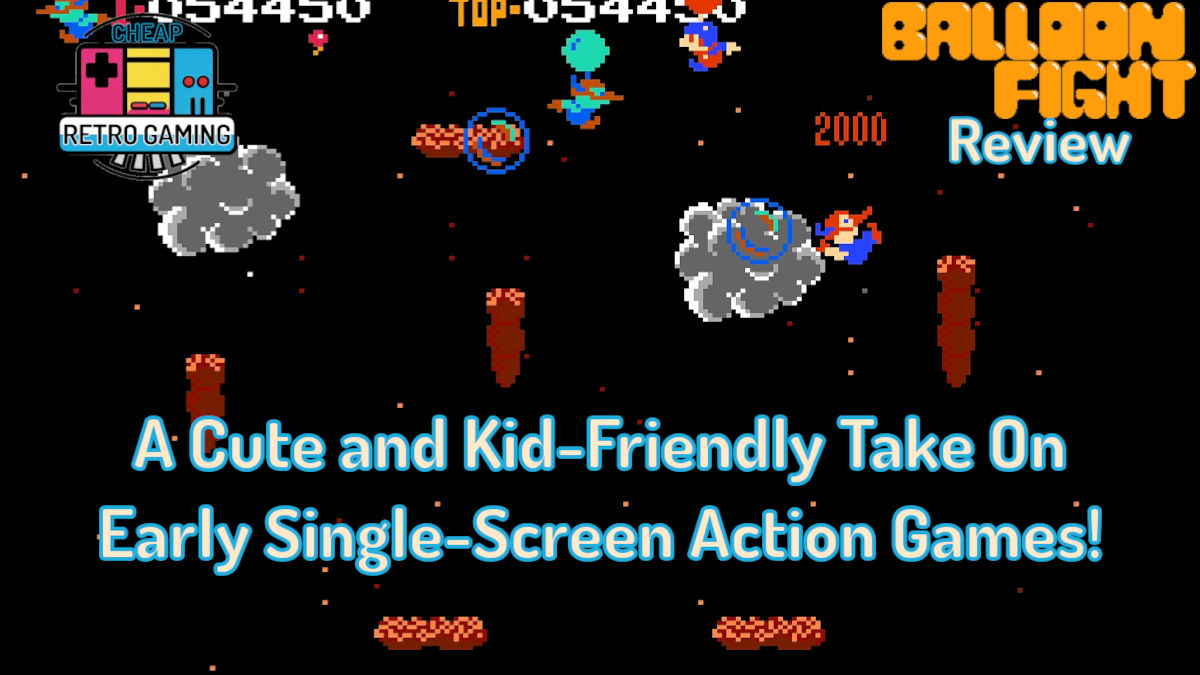
In the early years of the NES there were a lot of single-screen titles that had no scrolling. Many of these were of the Platformer genre. However, Balloon Fight was an example of an early Action game for the system. In a lot of ways, it was similar to Williams Electronics’ Joust (Review). It really seemed to be developed out of inspiration from that earlier arcade title.
Gameplay

In this one, you play as a boy that has a couple balloons attached to him. Pressing the B button causes him to flap his arms once to get up in the air a little bit. A button does the same, but has him flap his arms continuously. Doing this enough causes you to fly up in the air. Meanwhile, there’s also adversaries on the playfield who start pumping up their balloons at the beginning of each stage.
The goal is to get above your enemies so you can pop their balloon after crashing into them. Once you’ve done that, they start floating down to the ground with their parachutes. If you hit them again before they reach the ground you are awarded extra bonus points. On the other hand, allowing them to land safely may give them time to reinflate their balloon again. If this happens, they will be stronger than before and you will have to defeat them again. Once there are no more enemies on the stage, you move on to the next.
While it is nowhere near as intense as Joust, Balloon Fight does have a mechanism to encourage players to go faster. If you take too long, lightning bolts will begin shooting out of the clouds. They’ll bounce around the screen until they hit you and you lose a life. You can earn more lives by scoring a certain number of points.
One distinct aspect is Balloon Fight’s bonus levels. After every three stages you reach a screen that has four pipes pointing upward along the floor. Balloons fly out of these at random intervals and it is your job to pop them. If you do this for all 20 balloons, you earn a large number of bonus points. Each successive bonus stage has faster balloons, along with higher point values for popping them.
Like Joust, Balloon Fight has a two-player mode. This can be played either cooperatively or competitively. However, there is no built-in way to protect yourself from the other player. Some other titles, like Double Dragon II, allow you to choose whether one player can hurt the other. No such option is here. You just have to coordinate your attacks with the other player, or treat them like any other enemy. Based on who you’re playing with, it can be a lot of fun, or rather irritating! The stages don’t change in their design or layout compared to the one-player mode.
A couple of other key points are just how much slower it is than Joust. While Balloon Fight sometimes has 7-8 enemies on the screen at once, they don’t fly across the screen or try and smash into you as much. This means the game has a more relaxed tone about it than its inspiration. Furthermore, Balloon Fight has a more vertical feel to it, too. The platforms are usually narrower than in Joust, allowing you to move up more often on the screen.
Graphics

The previously mentioned relaxed tone also comes through in the form of Balloon Fight’s art style. All the kids are cute, and seeing a balloon pop is less threatening than being knocked off a bird. Plus, the way all the characters flap their arms is endearing, and fun to watch. Even my wife remarked about the game’s animation when she saw it.
Other than that, the graphics are what you’d expect for a game of this time period. Much of the background is black with a significant number of reused assets such as the enemy sprites and platforms. Nintendo’s Excitebike (Review) was a much more visually impressive game that was released just a few months earlier in Japan. It featured smooth scrolling and more animation.
Still, Balloon Fight is fun to look at, primarily because of its cute nature.
Music and Sound Effects

When it comes to the audio, I’m conflicted about it. Concerning the music, the most common tune that plays during the main game is irritating to me. It just feels like it is bashing my ears over and over again while listening to it. At least it doesn’t play all the time. There’s also a piece for when enemies are floating down in their parachutes. I liked that one, along with the small ditty that’s for completing a level.
The sound effects are simple, but fit the game well. Like the graphics, I cannot help but consider them charming. The sound effects somehow make sense with the gameplay and look of the title.
Perhaps my favorite part of the sound design is the music that plays during the game’s Balloon Trip mode. It’s also present in the bonus stages of the main game, but I expect most players equate the track to Balloon Trip instead.
Overall, the music is good in a simple sort of way, with some aspects it being irritating.
Balloon Trip

What’s not irritating is Balloon Trip, a single-player-only mode that has you going on an unending journey from the right side of the screen to the left. It continually scrolls, there’s no enemies to contend with, and the only obstacles are the lightning bolts. At the beginning of your trip, these are stationary, but begin to float across the screen after a short time.
The goal is to survive as long as you can on your epic trip across the sky. Along the way you pop balloon for bonus points, and after hit 20 of them, they change color and give you more bonus points with each one popped. Additionally, if you pop the bubbles that periodically appear on the screen, the scrolling will freeze for a few seconds, allowing you to catch your bearings before moving on again.
Even though I never earned a top rank in this alternate mode, it is probably one of the best things about Balloon Fight. It shows off the game’s control, music, and gameplay loop in a unique and addictive manner!
Final Thoughts

And the addictive nature of Balloon Fight is one of the best things about it. It was a lot of fun to try and increase my high scores in both the main game, and Balloon Trip. The tone of it is non-threatening, and it’s easy to play at the start for most gamers.
The animation style is cute and charming, and some of the music is quite catchy as well. The control and physics are also believable, in a childish sort of way.
My kids and I had a lot of fun with the game, and I think it deserves a Positive rating!
In comparison to Joust, can I say that one is better than the other? Not exactly. I think the big differences between the two is the relaxed nature of one and the somewhat intense parts of the other. Both add something valuable to the gaming space of the early 1980’s!
Review Overview

Summary: While Balloon Fight’s graphics are basic, the art style is cute. It also features some charming music, good control, and physics. Plus, Balloon Trip is really addictive! This is another quality game on the NES!
Title: Balloon Fight (Price Charting)
Genre: Single-screen Action
Year Released: 1985 in Japan on the Famicom and 1986 on the NES.
Developer: Nintendo and HAL Laboratory
Available On: The Famicom and NES, along with the Gameboy Advance. It can also be played on the N64 and GameCube versions of Animal Crossing.
Price Paid: $2.22, or $66.45 for the NES Classic Mini.
Remember, we can have different opinions about the games we play. If you like something more (or less) than I do, both of our perspectives are valid. Please see my Review Rating Scale to know more of how I rate games.
Leave a Reply