
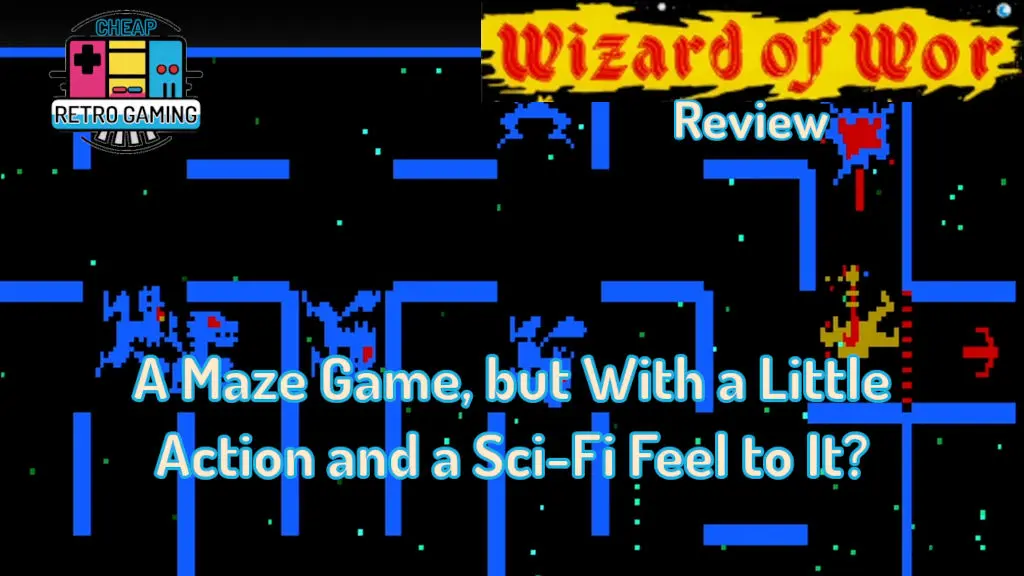
After the incredible success of Namco’s Pac-Man, there were a slew of new arcade games released with maze exploration and chasing mechanics. One that came out within a couple of years of that seminal title was Wizard of Wor, by Dave Nutting Associates. Outside of its sci-fi aspects, its big claim to fame was its use of digitized speech during gameplay.
Gameplay

Like other maze action titles from 1981, you move around the maze in the four cardinal directions with a joystick. You play the part of a Worrior, who looks a bit like an astronaut wielding a gun. As you make your way through the corridors, you can fire your gun one shot at a time at enemies to defeat them. Because the game features a means of both running away and attacking, it has more of a focus on action compared to some other maze titles.
Another distinguishing characteristic is the addition of a radar located near the bottom-center of the screen. While it doesn’t display the walls in the maze, it’s effective in pointing out where your adversaries can be found. This is important because Wizard of Wor calculates your line of sight in relation to where you are in the maze. After the first level or two, enemies are invisible on the top portion of the screen unless you’re looking at them. Sometimes you may only have a split second to shoot one after it appears in front of you.
In some ways this feels cheap, especially since you can only fire your gun one bullet at a time. If you tend to fire a lot, you’ll leave yourself open to an attack when an enemy appears right in front of you. At least with the radar there’s a warning of something coming your way. I found this extra element to be really innovative, and added a unique gameplay aspect to the game.

After defeating all the enemies on the stage, a final one will appear. It tries to escape the maze before you can kill it. Because of the game’s hectic sounds at this point, and this new foe’s high rate of speed, this is often one of the more gripping moments in a level. While it may only last for a few seconds, it was another part of the game that stood out for me. If you’re able to defeat him, then the next stage gives you double bonus points.
It’s a simple gameplay loop and it may not take too long to lose all your lives, but I found it to be quite addictive! Some runs only lasted a few minutes because I died so often, but the game also didn’t waste my time. While playing Pac-Man (Review), at times I felt like I had to retreat from where I wanted to go because I didn’t have any power pellets nearby. Action wasn’t a big part of the game. That’s different here since my gun didn’t run out of ammo and I could look at the radar to see where my foes were located.
Graphics

While doing the above, I found some of the game’s graphics to be run of the mill. A large portion of it was just a black maze with blue walls. Each of the characters had a few frames of animation as they walked around, at least. There were a decent variety of enemies to face, too. If you wait long enough at the attract screen you can see their names listed, which is typical of games from the early 1980’s. Surprisingly enough, I was impressed by the font of the text on the screen at certain points. When you hit the last enemy of the level the screen’s colors would go crazy, which was terrible for those susceptible to seizures. But after that, a neat font of large text would tell you that you earned double bonus points for the next maze. The same font is used at the game over screen as well.
What I liked the most from the graphics were the two pieces of cabinet artwork visible during gameplay. The bug on the left may have been a typical image from the time period, but I liked the space setting that was visible behind it. My favorite part was the character on the right side. He’s supposed to be the Wizard of Wor, and dominated the screen. Seeing the illustration of him, along with the accompanying voices, made me feel like I was really going up against him as I played. With the main character’s gun, and the metal face of the Wizard of Wor, I felt that the game had an interesting visual theme.
Music and Sound Effects

On the other hand, the part that impressed me the most was the sound design. Admittedly, the music was basic, with it seeming to only use one or two tones at a time. Yet, the way it picked up its tempo as the level went on, while the enemies also increased in speed as they moved around the maze, meant that the tension of the sounds and visuals complimented each other. The sound effects of when you fire your gun, or get killed and explode, both sound a bit like sci-fi to me, which I liked.
And what was really great were the voices! Admittedly, they were a bit difficult to comprehend, in comparison to how clear everything sounds today. Even the wizard’s “Ha! Ha! Ha!” came off as very robotic. But if I was playing this back in 1981 I would have been very impressed! There were multiple statements that the Wizard of Wor made as I played the game. For example, when I was doing well, he said, “If you get too powerful I’ll take care of you myself. Ha! Ha! Ha!” After I lost all my lives he mocked me with the words, “Hurry back, I can’t wait to do it again. I am the Wizard of Wor.” I could pick out at least 5-6 phrases he said, which was a lot! It’s a shame that some of it was a pain to make out. Yet, it was still impressive, and added a lot to the sci-fi element of the game.
I’m sure that one of the big reasons I played the game so much was because of how it all sounded. Even as I watched footage of my gameplay to grab pictures for this review, hearing it again made me like the sound design that much more!
Final Thoughts

As I reflect on Wizard of Wor, I can see how its gameplay can feel a bit basic. You are just walking around a maze and blasting monsters with your gun, after all. And sometimes it can be frustrating. Only being able to fire one shot at a time feels really slow, and I don’t think there are any power ups in the game to change things up. Plus, sometimes as I moved around, the game would knock me back to a previous square due to some issues with the hit detection. When this happened, it reminded me of just how old the game was.
Still, the gameplay experience became more fun as I progressed because I liked the way the graphics and sounds worked together! The synthesized voices were great to hear. Trying to make them out was also like a game in of themselves.
It all came together with a fast gameplay loop and an enjoyable two-player mode that increased my enjoyment of it. While the sound design with the voice work is definitely Very Positive in quality, I think the game as a whole deserves more of a Positive rating. The parts that knock it down a few pegs for me are the graphics of the maze, the long delay between shots when firing your gun, and some odd aspects related to the controls.
I wish there was a sequel to this, but to my knowledge, there isn’t one. I’m excited about discovering this game through the Midway Arcade Origins collection and trying out new-to-me games in the future from it! For those curious, the last game I reviewed from this package was Joust. You can find a review of it here.
Review Overview

Summary: Wizard of Wor is innovative in a few ways. It solves the problem of not being able to be aggressive against one’s enemies in typical maze chase games. Along with being fast-paced and having an addictive gameplay loop, it also features impressive sound design with its synthesized voices. I think it’s a great game!
Title: Wizard of Wor (Wikipedia)
Genre: Maze Chase Action
Year Released: 1981
Developer: Dave Nutting Associates
Available On: The Xbox 360, and also Xbox One and Xbox Series X|S through the Midway Arcade Origins. The same game collection is also available physically for the PlayStation 3. The Midway Arcade Treasures 2 disc also has it. That’s available for the Nintendo GameCube, Xbox, and PlayStation 2. Closer to the time of its original release in the arcade, it was also ported to some Atari systems and retro computers.
Price Paid: $0.17, or $4.99 for the Midway Arcade Origins compilation.
Remember, we can have different opinions about the games we play. If you like something more (or less) than I do, both of our perspectives are valid. Please see my Review Rating Scale to know more of how I rate games.
Leave a Reply