
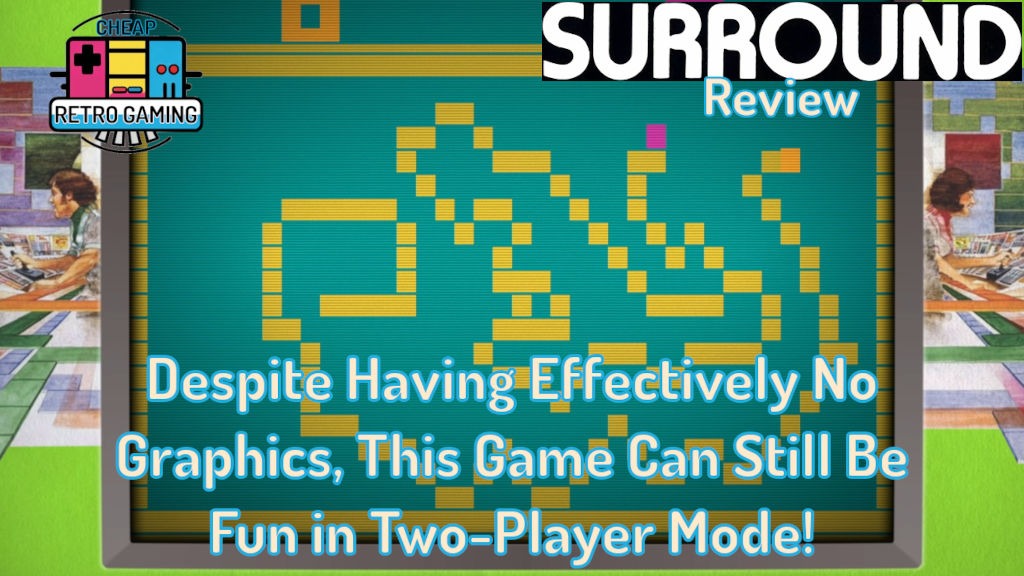
Although it’s not too popular today, the Atari 2600 had a good amount of launch titles back in 1977. I’ve already reviewed a few of them. Another was simply known as “Surround,” which admittedly didn’t tell us a lot about it. However, once I played it, I discovered that it was a two-player game of Snake! Shockingly enough, it was better than I thought it would be.
Gameplay

As the title told us, one of the main goals of the game was to surround the other player. This was done by wrapping a line, or wall, around them. As each character moved around the screen, a wall would be formed behind each of us. The hope being that the opposing player would crash into a wall before I did. Using the joystick, each of us could move in four different directions as we played. Thankfully, the game was playable in both single player and multiplayer modes. This was not the case for every game available at launch.
It didn’t seem like much at first, and I didn’t find it very interesting. Yet, I noticed that I could employ other strategies to help make my foe mess up. For example, I could carve out a part of the screen so that the other player would have less screen real estate to work with. Then I didn’t really need to surround him, but rather just last longer. In this way, Surround became a psychological test of endurance to see who could endure the most. At least in two-player mode.
Eventually, once someone crashed into something, a point would be added to the player left standing. The first to reach 10 points was the winner. I didn’t see a way to increase this score limit, but the game did have easy and hard options for difficulty when playing against the CPU. I was able to tell that the CPU performed better when playing in hard mode, which was a plus. Otherwise, I could win most of the time.
Sadly, most of the game modes were not available while playing single player. The only ones that could be enjoyed were easy and hard difficulties of the standard game, and a Speed Up version of the same. This latter one had the speed of the characters increase every five seconds or so. It made the game a lot more fun and intense because the sounds would speed up with one’s movement as well. Video Graffiti could also be played single player.
That last mode was an extremely primitive drawing program where I could place blocks on the screen to make crude artwork. It was mildly interesting, but mostly as a historical curiosity. My kids liked it, though.
Additional options for two players included moving diagonally, wrapping around the screen, and pressing a button to keep your line from forming behind you. For that last one, I have no idea why it existed. However, I’ve grown to appreciate how Atari often gave players a lot of options in their early games. Those various attributes could be mixed and matched as well. We especially liked the Speed Up option with Wrapping enabled. For those unsure what Wrapping meant, it made it so that when we reached the edge of the screen, we’d reappear on the opposite side.
The last thing I’d like to say about the basic gameplay is that the control was sometimes inconsistent. At least on the Atari 50 version, that is. I had to be quite intentional in how hard I pressed the directional button to move my block around the screen. My kids had some trouble with this aspect as well.
Still, we all really got into this title, and enjoyed it a good deal! I’d even have fun watching my kids play because of how the tension would increase as each match continued.
Graphics

Not that there was any reason to watch the game from a visual standpoint. Especially since the game essentially had no graphics. Seriously, I was just watching blocks move around with lines being made. The closest thing to graphics were the different colors the game would display based on the mode. As I tend to expect now, some of these were terrible looking or had limited contrast which made them harder to play. There was no nuance to the graphics. There was no variation in detail or shading to anything.
Another note I’ll add it that there was a lot of flashing that occurred when someone lost, though, which was a bit irritating. I didn’t see any option to change that for accessibility reasons.
Sound Effects

In addition to some of the awful color schemes, it probably also goes without saying that Surround has no music. The most common sound effect was the repetitive beeping that occurred with every step of the blocks. The only time this changed was when the game sped up in the mode I described earlier. The only other sound I noticed was the bang noise that reverberated after smashing into a wall.
Further Reflections and Comparisons to Other Titles

So, it’s obvious from the above 2 sections there’s literally no reason to play this game from a graphical or audio perspective. Except for Basic Math (Review), it was the simplest looking Atari 2600 game I’ve reviewed thus far. Although, I suppose I could say that these graphics were better, simply because Basic Math had me just looking at numbers.
The other title I’ve reviewed with multiple single player modes was Air-Sea Battle (Review). While it included some mildly decently shading and nostalgic sound effects, competing against the CPU was a joke. The enemy turrets would just fire at preset intervals, so I wasn’t competing against anything that had real intelligence. The two-player mode was better, but not by much.
To me, the best game thus far was Combat (Review). It had a good variation of maps and modes that contributed to some good competition against other players. Off the top of my head, the main thing I could fault with it was no single-player mode.
At least with Surround, it could be played single player with a real CPU opponent, unlike Air-Sea Battle. It was also a distinctive gameplay experience, as opposed to Basic Math. Thus, making it better than both of those titles in my eyes. Its graphics and sounds were much worse than Combat, though.
However, I must say that Surround was quite addictive at times, and I’m sure it had more depth with its different modes than many other titles that were available at the time. As I have already shared, it was even fun to watch when I wasn’t playing it.
Final Thoughts

Yet, trying to encourage people to play it today would be a hard sell. Primarily due to the primitive graphics and sound effects. We had a good deal of fun with it, and I’d like to play it more. I’m glad it was included on the Atari 50 Anniversary Celebration!
However, I think I will just rate it as Mixed because two of the main aspects of it were extremely poor. I paid $0.19 for it, or $20 for a game bundle.
Leave a Reply