
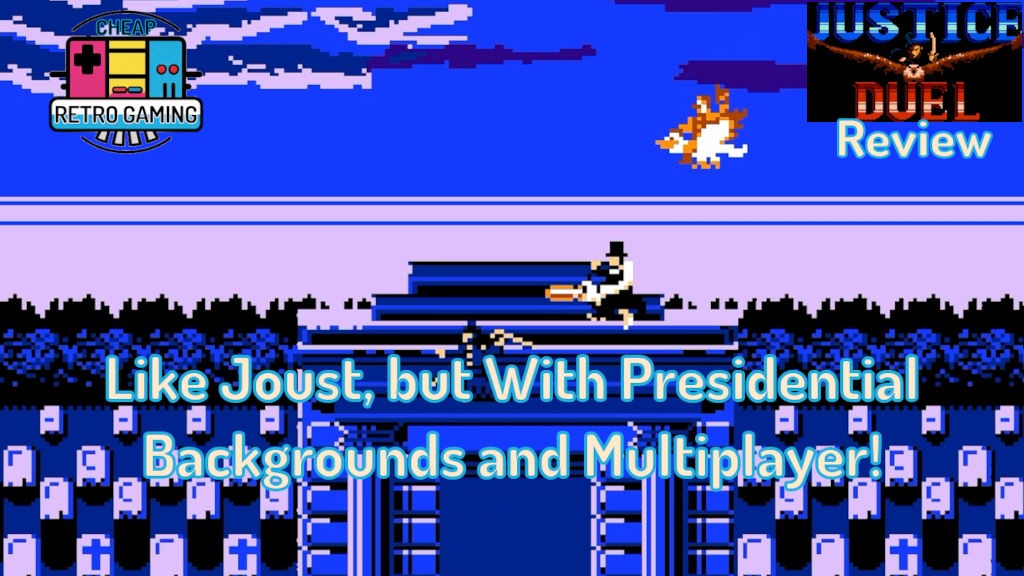
After playing one of the most popular titles on the Mega Cat Studios Collection 1 cart, we now come to another that is not so exciting. Perhaps part of the reason is because it came out before multiplayer was available on Evercade systems. Still, I was somewhat curious about this game because it was partly inspired by the classic arcade title, Joust. Like other releases from Mega Cat Studios, it’s rather tongue-in-cheek with its tone and premise involving AI and robotic versions of past Presidents and generals who ride birds. The game is titled “Justice Duel.”
Gameplay

As I just alluded to, it has both single and multiplayer modes. In them, one can choose from four different historical figures: Abe Lincoln, Theodore Roosevelt, General Lee, and General Grant. Other than the design of their sprites, they all play the same. I controlled my bird with the D pad, which allowed me to move left or right. The B button flapped my bird’s wings which made me fly upward after tapping it repeatedly. The A button was used to shoot a bullet across the screen. I had an unlimited supply of those, and could also pick up various special attacks for one time use. These included a hatchet, bear traps, or an egg that exploded when someone touched it.
There were also other beneficial items that would randomly appear on the playfield. Such as a heart that would restore some health or stars that acted like 1-Ups. After I lost all my lives, it was game over, with no option to continue. In the multiplayer mode, I had to wait until the next round to play again.
When playing the single-player mode, it began with a bizarre story sequence that was unique to each character, while also showcasing the best portrait art in the game. Like other Mega Cat Studios releases, I didn’t find these very funny, but since I’m used to them now, I’ve grown to be fond of their inclusion. I view them as part of the company’s identity. This one reminded me of Almost Hero’s (Review) opening cinema the most, even if the premise was very different.
Once I made it to the game proper, I fought in single-screen arenas with the goal of taking down one or more enemies with the weapons I described above. Being inspired by Joust, I could also fly above my foes and crash into them for additional damage. This was a key technique used by everyone in the game, but it wasn’t too much fun to perform. When I’d hit somebody, they’d just blink for a few seconds, which wasn’t very exciting. Unlike Joust, the game didn’t have one-hit deaths, or eggs that were dropped following the defeat of an enemy. This meant that there was less visual feedback when I successfully hit one of my foes.
Also, the AI was one note. Wherever my enemies were, they would just float toward me, with their primary means of attack being to crowd me out. This would cause me to lose a life in short order unless I got away from them quickly. Of course, I’d try to get to another ledge to regroup, but then they’d just start to float to me again. That was a bit boring, and when I was crowded too often, the game became aggravating. However, there was one foe who would routinely charge me, which changed up the gameplay a little.
Most of the time I’d win the round and move on to the next. In terms of game length, the single-player mode was made up of 4 sets of 5 stages each, for a total of 20 levels. Each set had their own background and stage layout, ending with a boss fight against 1 of the 4 playable characters.
Turning our attention to the multiplayer mode, my kids and I had some fun with it, and played on all the stages that were available. It was funny to chase each other around and try to defeat one another. However, the smaller ones had a little bit of difficulty figuring out which character was theirs. For myself, our fights were mildly entertaining, but I was surprised at how tame the hits felt against each other. The blinking effect just didn’t do it for me! I also noticed that I couldn’t play the game cooperatively in two-player mode, which would have been a great addition. Moreover, the fact that all the characters controlled and behaved the same way was disappointing. I wished that each was at least a little different in some way. I think this sameness, along with the tame hits, contributed to me feeling like the game was drab.
Graphics

Which was a shame, because I thought Justice Duel looked pretty good! At least when it came to its backgrounds. There were at least five different locations to fight at, with some examples being a forest, battleship, or capitol building. The background pixel art was pretty good, and quite busy. I think that latter aspect caused some players to have a hard time knowing where platforms were on the stage. I didn’t have much trouble with that since many ledges were color coded and I played much of the game on my monitor with the Evercade VS. While each stage had a distinctive layout, the places where the platforms were didn’t have an impact on how I played the game.
Beyond the backgrounds, I also especially enjoyed the portraits in the story sequences of the single-player mode. These weren’t animated, but they were well colored. It was neat to see historical figures from America’s past redone in a robotic form. I wish that there were more of these, specifically after beating bosses, but it was not to be. Perhaps there could have been funny little statements when reaching a boss instead? That would have contributed to the game’s personality, at least.
While the portraits looked good, the size of the sprites were quite small. Especially when playing the game on a portable screen, such as a Super Pocket, they were challenging to see. Not only were they small, but they also didn’t have much animation. I only noticed 2 or 3 frames for each action a character performed, thus making the visuals stale and lifeless most of the time. Despite the different sprites for the characters, it was possible to lose sight of them. This became less of an issue with repeated play sessions, but I feel compelled to mention it again anyway.
Finally, I found the standard enemies to be boring. Most of them appeared to be humans floating around with their arms out stretched. They reminded me of Chinese vampires from Phantom Fighter (Wikipedia) on the NES, but whatever. Some had white clothes on, others black, and another was a reddish tint.
Music and Sound Effects

Earlier I shared that I thought that Justice Duel’s gameplay wasn’t very compelling. Sadly, I can say the same about the music and sound effects. Most of the time, anyway. At least I enjoyed how the title screen music began with an appropriately patriotic tune that was nostalgic to hear. For about five seconds it sounded quite historical, and then changed into something much more upbeat. This was typical of the game’s score, sounding like one theme, and then changing into something quite different after a short time. I liked how this was done on the battleship stage for some reason, but most of the time I just thought it sounded odd. It was like the game had to compensate for its less than great gameplay with rambunctious music.
Concerning the sound effects, I didn’t care about them at all. They just seemed like a bunch of beeps and boops, letting me know that I hit an enemy or was damaged. Like I’ve already said before, there was little weight behind the attacks, and the sound effects didn’t help either. At least they weren’t absent, which is far from high praise.
In Comparison to Other Titles

The big problem with Justice Duel, to me, was that while I was playing it, I wished I was playing something else. I couldn’t help but think about how inferior the sprite work was in comparison to Joust (Review). That classic game had great animation, physics, and impactful hits against the other birds. For those seeking an experience with more exploration elements I’d recommend Spacegulls from Morphcat Games. Although I haven’t reviewed it, I played it in the past, and it included a lot of aspects that made Joust so great. It also has a two-player cooperative mode. It’s available on the Morphcat Games Collection 1 for Evercade, and for free online at itch.io.
For those desiring more single-screen multiplayer action, there’s Super Homebrew War (Review) on the now Legacy Indie Heroes Collection 1 cartridge (Review). Even though it may be boring at times during single player, the multiplayer mode was much more expansive and diverse. Each of the characters played differently, the backgrounds were simple but easy to understand, and the music was catchy. Although, keep in mind that many people didn’t think very highly of it, but my kids and I had some good fun with it. An alternate version of the title is available at itch.io with a name-your-own-price option.
Final Thoughts

Unfortunately, after stating the above, I think my readers will know where I am going with this. Justice Duel’s backgrounds were detailed and colorful, and the portraits shown in the story sequences looked impressive for the NES. Too bad I didn’t like anything else about the game. The only other thing that came close was a couple of the music tracks, but man, I this was boring! I couldn’t get past the stale gameplay and poor animation.
As such, I have to give Justice Duel a Negative rating. I paid $2.52 for it, or $25.18 for the Mega Cat Studios Collection 1 cart. If you somehow wanted the physical cart for your NES, it’s available from Mega Cat Studios’ website. You can also see what Blaze has to say about it at their webpage.
If you’d like to read some of my other reviews from the Mega Cat Studios Collection 1 cart, please see Almost Hero, Super Painter, Multidude, Coffee Crisis, Log Jammers, Creepy Brawlers, Little Medusa, or Tänzer. I liked all of these titles more than this one.
The last game I’ll review from the cartridge will be Old Towers. If first impressions are any indication, I’ll like it way more than this as well.
Leave a Reply