
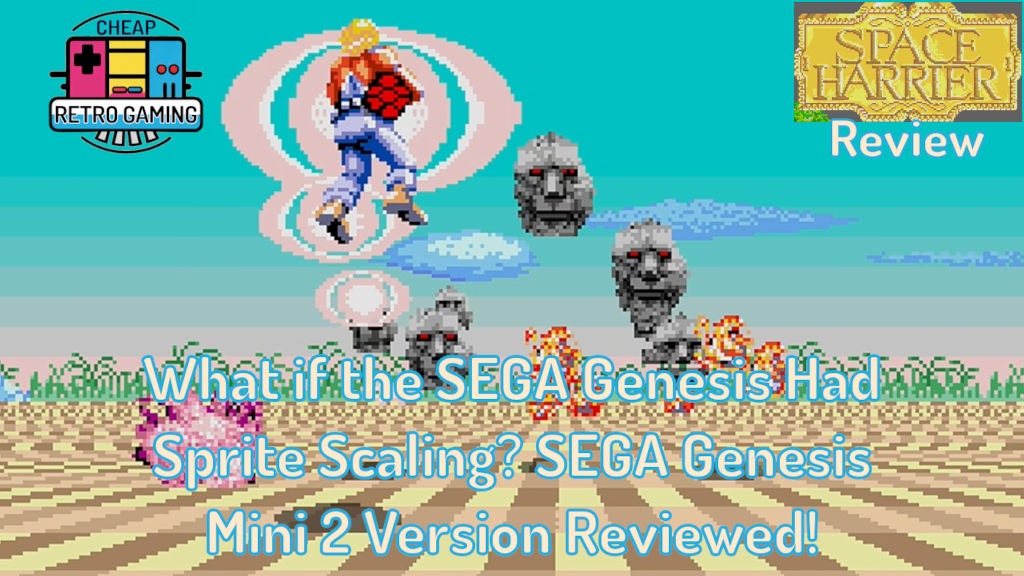
When it comes to video game history, it’s intriguing to question some choices from the past that impacted how certain systems were perceived. For example, what if The Legendary Axe was the TurboGrafx-16’s pack-in game instead of Keith Courage in Alpha Zones? What if the PlayStation 3 was easier to program for than the Xbox 360? What if the SEGA Genesis or Mega Drive had sprite scaling capability built into their hardware? These are fun to consider at times, with the last one being answered in 2022 through the release of Space Harrier for the SEGA Genesis Mini 2.
Since it’s a hidden game, to access it, go to Space Harrier 2, select it, and a new menu appears giving you the choice of playing either the first game or the second. Once you’ve done so, a unique bootup animation plays for the SEGA Mark V, a virtual console M2 developed just for these versions of Space Harrier I and II.
After that, the title screen appears, with all the major characters present and the Space Harrier logo flipping to the foreground. Both the mech and the woolly mammoth are present, along with the player character waving to you. Upon hitting Start, the game begins with its satisfying “Welcome to the Fantasy Zone!” and you running along the ground with trees and foliage nearby.
Gameplay

As one would expect, you move your character around with the D-pad, while pressing buttons on the controller fire your gun. As is the case with other versions of the game, there’s no power ups. There’s also no way to speed up or slow down, unless you count crashing into shrubs, which is not recommended. The control is smooth and responsive. When it came to input delay, I didn’t notice it playing too differently from Space Harrier II. Any sort of delay wasn’t a problem for either game.
Each stage is made up of its own series of hazards and enemies you face. Some you can destroy, others you simply have to avoid. Each level ends with a boss fight as well. If you play well enough, there’s also a bonus stage where you ride a beast and destroy trees for extra points.
In the options menu you can reverse the up and down movements of your controller, turn rapid fire on and off, and enjoy the game’s music with the sound test.
Graphics

From the very beginning, I liked the look of the game. There was a lot of detail on the title screen and the characters were a good size. They looked bigger than in the TurboGrafx-16 version, as well. The flipping of the Space Harrier logo was also well done. I felt like the title screen was much more compelling than Space Harrier II. The latter didn’t have any enemy characters on it and was just a black background with text on it.
Upon starting the first stage, my initial impressions were quite good. While the colors weren’t super bright, I liked the look of it anyway. Moreover, the resolution and details in the trees and shrubs were good. But then enemies started appearing and I began firing my gun. A new challenger appeared! Flicker!
And boy, was it bad!! In fact, it’s the worst I remember seeing in my recent gaming life. Here, it’s unavoidable. Even when I didn’t fire my gun, there was still a lot of flicker and garbled graphics. It was almost constant!
Just in the first stage alone, there was a part where two waves of enemies came near the middle of the screen to attack at once. When they were together, it was literally impossible to count how many there were because so many were invisible due to flicker. Moreover, at the first boss, when he fired his fireballs at me, they’d remain stationary on the screen for a while, but only through a cheap-looking blinking effect. This made me question whether the fireballs were really there, and yeah, they were. I died from touching one! Also, when the green dragon would fly away, its body would flicker like crazy.
Admittedly, there was a way to reduce the flicker in the game. That’s by putting in a secret code as you enter the option menu. This was done by holding right on the D-pad and then hitting Start when going to it from the title screen. If you’ve done it successfully, there will be a new option to turn deflicker on with modes ON1 and ON2. I tried both and they did help, but not entirely. The best thing about them was that they made the fireballs at the stage 1 boss be persistent instead of flickering a bunch. However, for the purposes of the review, I am describing the prevalence of flicker based on the deflicker modes being off.
If we could somehow ignore the flicker, I’d say that the detail of the sprites in this version is really nice. The largest size of some of the enemies is particularly impressive, even for basic foes such as the initial space ships you face. I also appreciated the graphical resolution of the hazards in some stages, like level 6 with its Towers of Control (graphical list of Space Harrier enemies from a different site).
Finally, the smooth movement of the game was very cool, and sometimes impressive. One good example was at the stage 2 boss with its large number of heads that rotated around smoothly as they fired at me. The flicker here wasn’t too bad, and it was enjoyable to take it down before moving on to the next stage.
Still, flicker was a big part of the game, even if I tried to ignore it. I will discuss it again later. But as an aside, I’d also like to point out that there have been a couple of other games that I’ve already reviewed that have had particularly bad flicker. These include PLOID and Almost Hero, both of which are NES titles available on the Evercade family of systems. On the other hand, Pac-Man and Flea! mitigate their slight flicker issues in reasonable ways. Both of them are on the NES as well.
Music and Sound Effects

Like the stage 2 boss, another enjoyable aspect was the music. The way Space Harrier begins is so great, with its catchy tune and the “Welcome to the Fantasy Zone!” I enjoyed the melodies a great deal, and they sounded a bit more nuanced than the TurboGrafx-16 version. The latter seemed harsher than this one when I played tracks back-to-back on YouTube. I guess we can thank the Yamaha FM sound chip in the SEGA Genesis for that!
The sound effects were also good, with satisfying explosions and sound effects for firing your gun. I did find it funny to hear the farting mushroom sound effect from stage 3 again. For better or for worse, that is one part of the game that I always equate with Space Harrier now that I’m used to it.
Further Reflection

To me, the most compelling part of this release was showing us a real example of what the SEGA Genesis/Mega Drive could have been like if it had these capabilities back in 1988. What 1st and 3rd party titles would have been produced during its retail lifetime if it could do this? Surely, we missed out on some interesting releases because the Mega Drive’s sprite scaling capabilities were significantly less than arcade hardware. If it did have this ability back then, I think it would have been incredible, and maybe it would have made the SNES’ Mode 7 features seem less impressive.
However, the big problem with how this version of Space Harrier was made was just how much image quality was impacted. In some ways it was quite impressive. But the truth is that the game is filled with flicker! It’s impossible to ignore. It was so bad that my kids have dubbed this version “Space Flicker 1!”
As a SEGA fan, that kind of stabbed at my heart! But I can’t say that their viewpoint was all that wrong.
From my perspective, what this version of Space Harrier does is it shines a light on how much simpler Space Harrier II is in comparison to its predecessor. You may recall that in my review of the sequel the flicker in the SEGA Mark V version was bad, but not nearly as much as this. I think the reason being that Space Harrier II has fewer sprites on screen at once than in this game.
Sadly, here it is downright atrocious. That one of the main reasons why I am more impressed by the TurboGrafx-16 version of the game (Review) than this release. Especially since that one was running on stock hardware.
Final Thoughts

To sum up, Space Harrier on the SEGA Genesis Mini 2 had impressively smooth scrolling, but only when little action was happening. Once a bunch of objects appeared on the screen, it fell apart from a graphics standpoint. I found the flicker to be extremely distracting and odd to watch. it made me think that the system would crash at any moment (but of course it didn’t). Maybe I’m blowing that aspect out of proportion, but from my eyes, it was awful. The music was probably my favorite part of the game, along with its quality controls.
Yet, the good controls are present in other versions of the game, along with a more balanced visual performance. As such, I’d rather just play the TurboGrafx-16 version again even though I don’t like its musical renditions as much as here.
Because of that, I feel compelled to rate this SEGA Genesis Mini 2 version as Mixed, which is honestly a shame. I paid $2.03 for the game, or $123.93 for the SEGA Genesis Mini 2 as a whole.
Before ending this review, I’d like to stress one big thing. I wouldn’t recommend people picking up the SEGA Genesis or Mega Drive Mini 2 specifically for this game. I expect that even Space Harrier super fans may be disappointed with it, and I don’t want them to feel like they wasted their money. Especially since the console is only available at a marked-up price now.
Also, this is my first review where I am not going to prepare a Review Overview. According to my stats, very few people clicked on the links they had, and the section takes a good deal of time to prepare.
Leave a Reply