
Over the decades, some video game characters have become so popular that they have their own product lines beyond the world of gaming. For instance, there’s tons of stuff available for Sonic the Hedgehog, Mario, and Pikachu. Some examples include t-shirts, alarm clocks, and costumes.
Another popular character is the slime from Dragon Quest, who represents the series as a whole! After a quick Google search, I learned that merchandise in the shape of the character can be found on t-shirts, key chains, mugs, ice cube trays, and lots of plushies! Back in 2019, Square Enix even released a baby’s board book featuring their slimes! In English it’s referred to as “Slime Pipipi.” The Japanese name for it is スライム ぴぴぴ (Suraimu Pipipi).
It’s aimed at Japanese infants and toddlers from the ages of 0 to 2 years. As such, don’t expect any high degree of literature here! But since Dragon Quest and its slimes are both a retro game series, and collection of classic characters, I thought some of my readers may enjoy learning about the book. Furthermore, I have a have an interest in the Japanese language due to Japan’s varied forms of entertainment, so I decided to review it.
Starting the Book
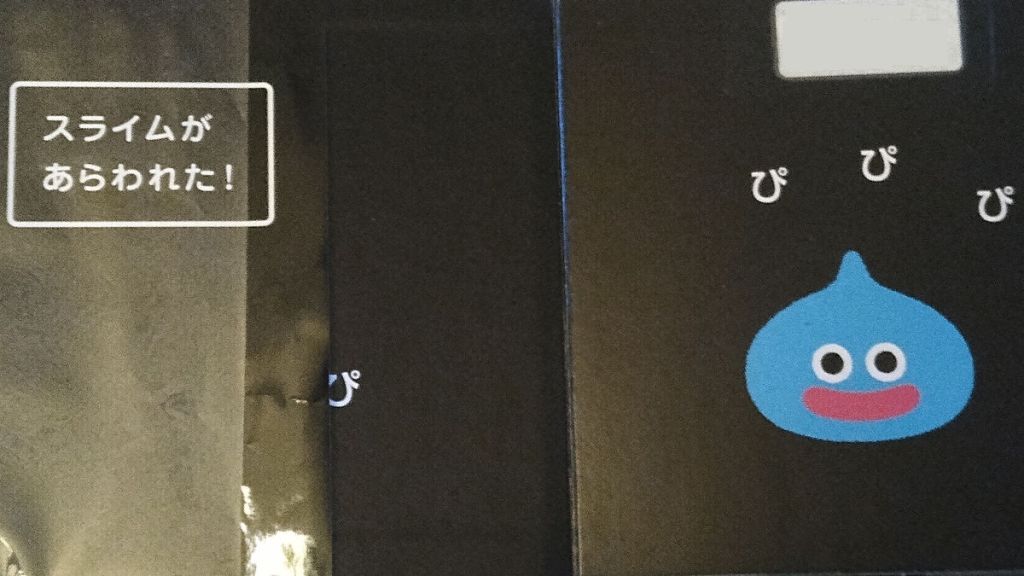
After admiring the book’s cover with all its various slimes, opening it up we’re immediately hit with a mix of nostalgia (for Japanese gamers) and cuteness! The inside cover tells us that a slime has appeared, matching the text that was found in the Japanese version of the original game. The right page then has a blue slime with the statement of “Pi pi pi,” which obviously corresponds with the title of the book.
At first glance, Slime Pipipi seems to be extremely basic on a grammatical level, as one would expect from a title designed for children who are newborns to 2 years of age. The simplicity continues throughout the rest of the book, with many pages having only a phrase or two on each. Many of these are onomatopoeic words that describe the sound effects the slimes are making as they walk down the stairs or fall down from their stacks.
All the while the various slimes have funny looking expressions all over the place. My kids and I enjoyed looking at the absurd faces of the characters as they progressed through the little story.
Artwork
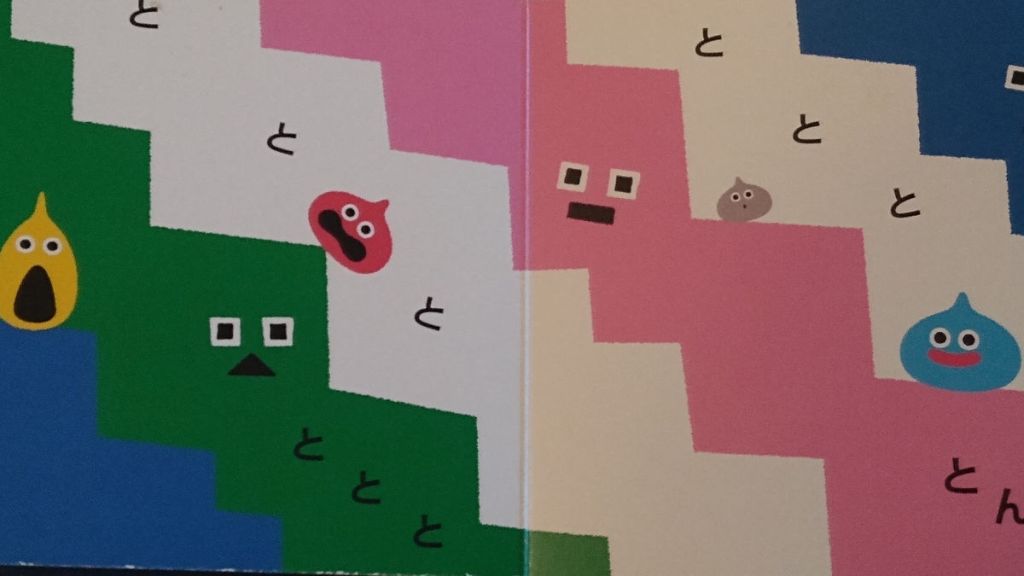
Since this is such a simple book, it can be enjoyed on the basis of its artwork alone, despite it being in Japanese. There’s a good variety of slimes in it, and I was surprised to find such a wide spectrum of colors for each as I read it. Perhaps one reason why was because my Dragon Quest experience stems from when it was known as Dragon Warrior in the USA. I haven’t played anything past Dragon Warrior VII on the PS1. Just as an aside, I’ll also add that I was overjoyed to see at least one babble (bubble slime) as well! They were a noteworthy enemy for me in Dragon Warrior II on the NES.
The slimes are usually represented with simple colors, with one shade being used at a time. Backgrounds are one color as well. While such a limited palette may be a bit boring for older kids, for the intended audience, it’s totally fine. Differences in color stand out easily, with a variety of shapes and expressions. Again, the faces of the slimes are charming and funny, and I liked to see them move around the page. My kids pointed out some of the facial expressions and liked the look of the slimes as well, even though they’ve never played the games.
Story and Dialog
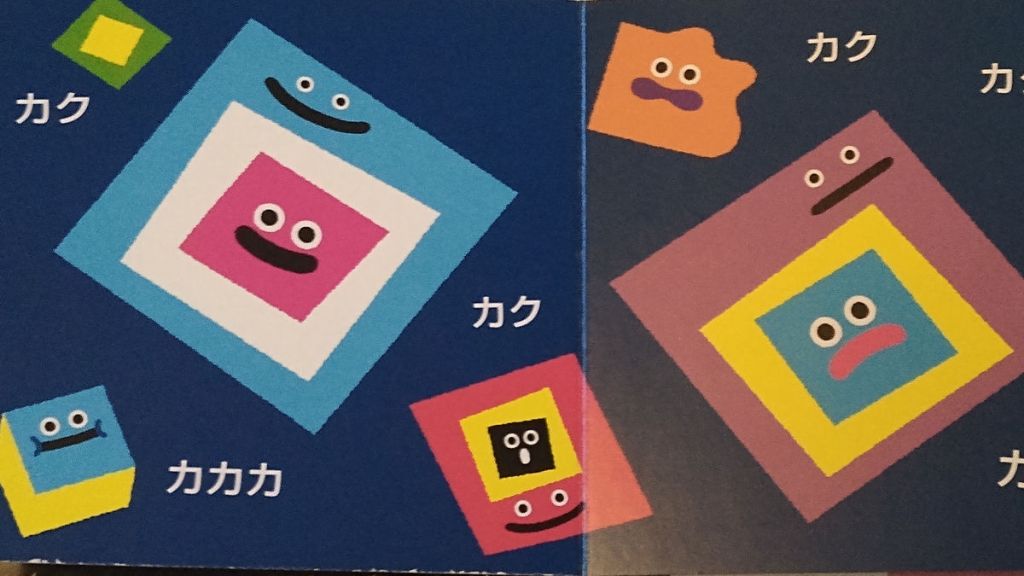
Like I’ve already said before, this book is in Japanese. As such, you’ll need to know the words or use a translation tool to read it. Not that it is a huge deal if you can’t. After all, many of the pages have just one phrase or two that goes along with what’s being shown in the pictures. For example, カク (kaku) can be used to refer to a square or cube, which is fitting on the page where a lot of the slimes appear like those.
One of my favorite pages show a few slimes climbing on top of each other, like they’re stacked up. They then try and trot around. Of course, this doesn’t go well, and they fall over. Depending on how you look at the words on the page, nearby one sees おっと (otto) for oops, uh-oh, or sorry, or とっとっと (tottotto) for the sound effect of trotting around, or doing a series of taps. On the other side of the page there is a slime that looks squished. Above that one is the word べちゃん (bechan). This is extremely similar to べちゃんこ (bechanko), which according to jisho.com means “Squished flat.”
Statements like the above are some good examples of what you can expect from the book. It’s so simple that I don’t think you need to know the Japanese to enjoy it, assuming you’re a little kiddo. For parents out there, I recommend that if you end up buying it, at least learn how to read the hiragana so you can sound it out to your kids. Mine liked hearing me talk in some terrible Japanese as we went along and laughed at the funny looking slimes.
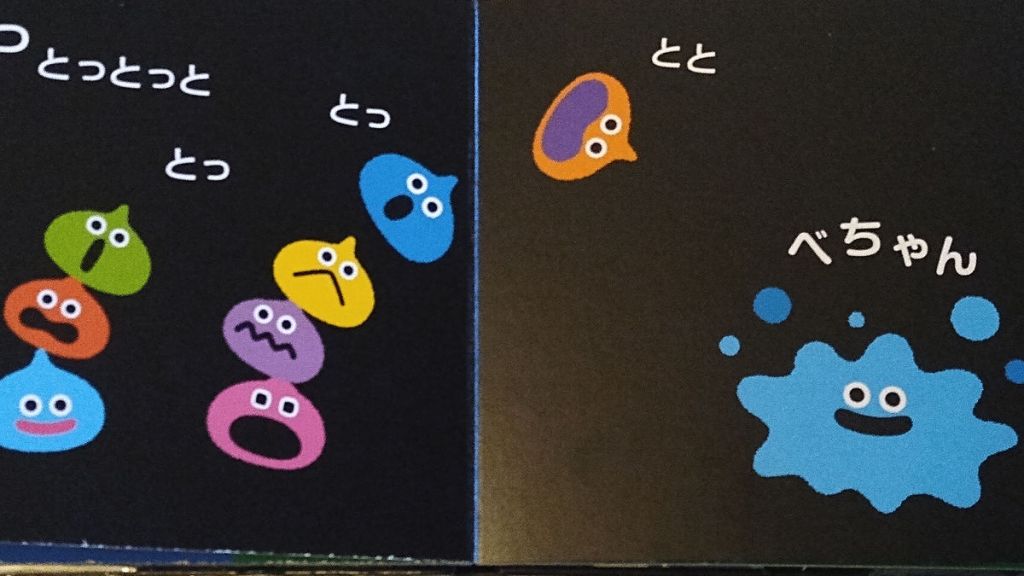
From the perspective of an adult relearning Japanese, I liked some of the moments where the phrases are cut off or repeated. They’re good for basic pronunciation practice for neophytes learning the language. I was able to find translations of many of the sound effects used in the book at The Jaded Network (tottotto), with more normal words at Jisho.com (suraimu). Both of the preceding links take you to specific search terms used in Slime Pipipi..
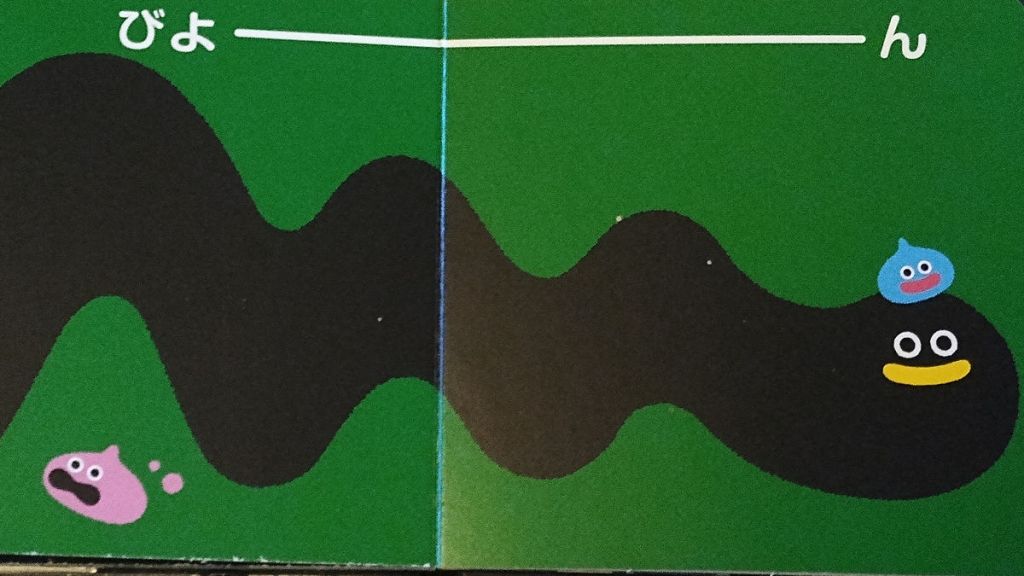
My family liked the big climax at the end. I’m sure that many younger kids will really be able to get into that moment!
Final Thoughts
Before sharing my final thoughts, I want to reiterate that I’ve been trying to review this book from the perspective of its intended audience: young children that are two years old or younger. Based on my own experience with it, and reading some reviews for it online, it seems to be very popular and well-liked.
I found it to be quite charming and fun, with entertaining expressions on the slimes and a few silly Japanese statements. After reading it a few times to my kids, they were done with it and ready to move on. Of course, they are older than the book’s intended audience, but they still enjoyed it.
From the viewpoint of a young child, I think this is a great board book. The pictures are funny, the Japanese is easy, and the reveal at the end is fabulous. It’s for those reasons that I’m giving it a Very Positive rating.
Adult fans of Dragon Quest may also want to check it out, but only those who are diehards. I’m thinking of those who already have a slime plushie and multiple copies of the different games. For them, I think the book will be a fun conversation starter to place on their shelves.
If you do want to check it out, links can be found below. Unfortunately, the price at Amazon has gone well above what it should be. As of this writing, Play Asia and CD Japan have the book available at reasonable prices (before shipping). If you want this as part of your collection, perhaps you could purchase it with some other import games or media. As much as I liked Slime Pipipi, I wouldn’t pay scalper prices for it.
Review Overview

Summary: From a perspective of a young child, Slime Pipipi is a lot of fun! The characters have silly expressions, the Japanese is simple, and the ending is great! Just know that it really is just a baby’s board book with slimes in it, so keep your expectations in check.
Title: Slime Pipipi
Genre: Kids Board Book
Year Released: 2019
Author: Pekori Hara
Publisher: Square Enix
Available On: Amazon, Play Asia, and CD Japan.
Price Paid: Free, I checked it out from my library.
Remember, we can have different opinions about the games we play. If you like something more (or less) than I do, both of our perspectives are valid. Please see my Review Rating Scale to know more of how I rate games.
 Cheap Retro Gaming
Leave a comment