
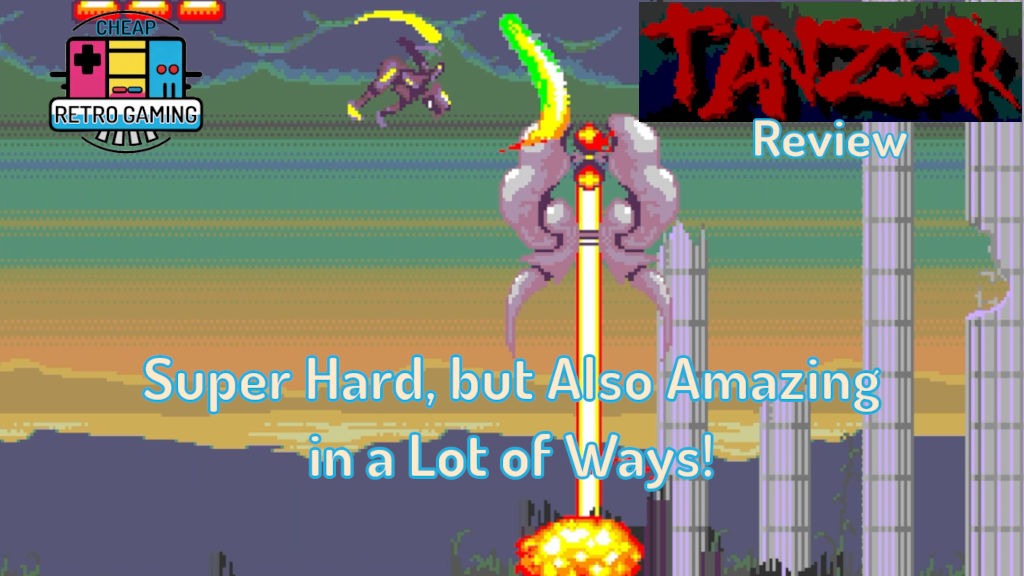
As I’ve shared in other reviews, there are some titles that have a great reputation and tend to be viewed very favorably in the Evercade community. One of the first games where this was the case was with Tänzer, a hardcore side scrolling action game developed for the SEGA Genesis. It was inspired by such classics as Hagane on the SNES and Capcom’s Strider. While it can be purchased individually as a regular SEGA Genesis cart, it’s also included as one of the ten games on the Mega Cat Studios Collection 1 cartridge. Amazingly, when Blaze designed the cover for their release, the game was omitted! It was only shown on the back, for some bizarre reason. That’s really surprising, considering how popular it is!
Gameplay

When I first started it up, it was obvious that the game had a lot of style and intentionality behind it. The opening text screen said, “All I ever wanted was to… Dance.” At first glance, that was a weird statement, but it somehow fit with the game’s title and tone. The title screen featured energetic music and a rapidly flashing image of a dancer on the right side. Once I knew that Tänzer was German for “Dancer,” things started to make more sense.
Before starting the game, I went to the options menu to change the button layout to match what was typical of Genesis games back in the day. For those who don’t know, that meant that buttons A, B. and C were in a straight line. To play the game, I used the D pad to move my character around. Pressing B made my dancer do a normal attack and C to jump. The latter could also be pressed a second time to perform a double jump. Holding up on the D-pad while in the air even allowed me to perform a triple jump! While pressing the B button, I could also hold up or down to attack above or below my character as needed, which was a lot! The upward attack was a critical aspect of the game’s design since a lot of bosses were on a higher platform than myself. I could also attack while jumping in the air. The A button was used for special transmutation attacks once they’ve been purchased from the shop. What these did sometimes changed depending on whether I was jumping or on the ground as well. The big takeaway from all this was that the movement capabilities of my character were incredibly strong. Except for when I was hit by an enemy, I could almost always do an offensive or evasive maneuverer that helped me advance in the game. At least if I was playing proficiently. My character’s capabilities could also be augmented by other items available at the store or in certain stages.
Not that I was able to obtain many of these in my first few play sessions. Especially since the game was hardcore in its difficulty, with only one life given to complete it. Sure, my character had three hit points, and I could buy some of that back in the shop between stages, but I never found a way to permanently increase my hit points to four. For those playing on original hardware, it was good to know that I could purchase a save state from the in-game shop, but it was extremely expensive. Since I bought this for the Evercade, I used save states at times to complete the game with the bad ending. If you play it as intended, just know that it was extremely punishing and brutal, sometimes even more so than games originally released in the 1990s. Those often gave players multiple lives or the ability to continue at least a few times. There was no such luck here!
Despite its brutality, I have to admit that the analogy of a dance made a lot of sense. The ways that the enemies attacked repeated a lot, so I was able to finetune my strategy to defeat them when they’d appear. Sometimes It would be best charge at them quickly since their bullets would fly upward and then fall back down. Others I could jump at in a quick manner because they would freeze in place for a moment after they shot their laser beam. Finally, I especially enjoyed using my earth transmutation attack because it would block some bullets on the screen. That was quite useful against bosses.
Another aspect I noticed was bullet speed; they were actually slow most of the time. Normally I’d get hit due to my own poor performance as a player, not because of their speed. This was further highlighted by the game’s great hit detection. It was so good that I able to consistently jump between small showers of bullets to hit my enemies. It was great to experience, especially since I was able to achieve the feat so often. Yeah, I could dodge bullets in other action games, but it was more impactful here because my abilities to move around and attack were so diverse.
And that diversity was one thing that made this game special. Off the top of my head, I can think of at least 4 different normal attacks your dancer can perform, along with 4 types of elemental transmutation special attacks, another long range weapon that can be purchased in the shop, and permanent upgrades skilled players can acquire through normal gameplay. On top of that, the game was made up of at least 8 distinct areas and 40 stages.
From a gameplay standpoint, the only way that I could sum it up was to say that it was very impressive.
Graphics

Along with that gameplay, the game also featured a distinctive mixture of typical, and also unusual graphics in its art design. As I jumped around and defeated a bunch of enemies, some of them looked like ships or robots from a sci-fi show that shot laser beams at me. Others appeared as if they were right out of the old west, with double-sided horse heads or cowboys losing their heads. The look of the game was also quite diverse, with it featuring time travel from one period to another all over the world. One stage took place on an old ship, another in a mine, and still a third looked a bit like Greece or Rome with its columns.
Another unusual graphical choice were the boss designs. They could have been anything! I fought against a large beast once, another time I took down a big floating fish, and more often than not, there were people who were being hanged or burned at the stake attacking me! These latter examples were very early in the game, so from the onset I had no idea of what to expect from Tänzer, at lease aesthetically.
I also noticed the significant amount of gore rather quickly. Some of it wasn’t too serious, like when I would get hit by an attack. But typically, boss encounters included a good deal of blood as I kept hitting them. I didn’t see a place in the settings to turn that off. On the other hand, there were a couple of performance options that could be toggled. One was for the animation that played while picking up gold and another kept the game’s weather effects at a normal level instead of increasing it. These latter choices were good inclusions since the game slowed down at times. It wasn’t terribly bad, but certain sections could make the game chug a bit. This typically happened when there was parallax scrolling, an enemy exploding, and a few others shooting bullets at me. Some times this slowdown only for a couple of seconds, but it could be more pronounced depending on the situation.
Still, the game had an impressive appearance in the areas of artistic design and what it achieved on a technical level.
Music and Sound Effects

Since the game directly references dancing, it was no surprise that music was a big part of the experience. From the very beginning, the tunes were pumping! Even at the title screen it made me want to just stand there and listen to the beat. This was further highlighted by the wave effect in the background and the silhouette of the dancer flashing at the bottom-right corner of the screen.
Admittedly, there wasn’t a massive amount of variety in the soundtrack as I played. But frankly, I didn’t care too much since it was so enjoyable. Even after hearing it a lot! As indicated by the game’s sound test, it had about five different stage themes along with at least one boss track, a level clear tune, and a shop theme. Most of them were catchy and upbeat, and I’m sure many people will spend at least a few minutes listening to the tunes. They really heightened the excitement of the game, even when the bullets were a bit slow, knowing that any damage I took was a big deal. The only way to restore hit points was to buy them at the shop or find them in the stage. None were recovered after beating a stage or a boss.
The sound effects were also high quality. However, they took a bit of a back seat to the music since the compositions were so pronounced. The effects were still good, though. I enjoyed the sounds of my attacks and the explosions, which was what I heard a lot of the time. The only effect I didn’t like was what it sounded like after being hit. It was slightly irritating, but that was only a minor quibble.
The sound effects added a good deal to the game, even if more often than not, I just focused on the great music instead!
The Question of Difficulty

The biggest thing that potential players need to know about this title is just how unforgiving and difficult it will be to complete. If you’re like me, you’ll die a bunch while playing, and it could be very frustrating. However, it also has an extremely high skill ceiling and a large number of levels. As such, the game rewards competent play and practice. Get good at it, and you’ll be able to enjoy more of what the game has to offer. Which is a lot!
On the other hand, I don’t think Tänzer is a good choice for everyone. Those who have a hard time rage quitting, or would rather have a more moderate level of difficulty may want to look elsewhere. And considering the diversity of titles on the Mega Cat Studios 1 cart, there’s no other side scrolling action games to play in place of this one. The only ones that have any chance of being barely similar are Almost Hero (Review) and Coffee Crisis (Review), but both of those are Beat’em Ups. They’re also much less impressive titles.
Final Thoughts

Despite the difficulty, I was one who quickly viewed Tänzer in an impressive light. After reflecting on the major aspects of the game that don’t involve challenge, I have to say that I had a very positive experience with it in all the metrics I judge games by. The controls were great, with a lot of different attacks for my character to perform, and precise hit detection so I could dance around the screen effectively. The cool factor of the title was also heightened by its intriguing art design, which was weird, but at other times familiar. Finally, the music was just pumping!
But now I need to come back to the difficulty. What do I think about that? Yeah, it was tough, and I admittedly used save states to work around that at times. But I always felt like I could complete the challenge I was faced with because the gameplay design was so precise and effectively realized. I’m also confident that with a lot of practice, I could make my way through the game to a large extent. Not because I learned where all the cheap parts are, but due to the developers giving me the abilities to take on the game’s challenges. To me, that’s a sign of a quality title that just so happens to have a high difficulty.
As such, I can’t help but give this game a Very Positive rating. I paid $2.52 for it, or $25.18 for the Mega Cat Studios Collection 1 cart. You can buy the individual game physically from Mega Cat Studios’ website. You can also see what Blaze has to say about it at their webpage.
Other games I’ve reviewed from this cartridge include Almost Hero, Super Painter, Multidude, Coffee Crisis, Log Jammers, Creepy Brawlers, and Little Medusa. The next game I’ll review from this cart will be Justice Duel.
For those curious, after writing the above paragraphs, there were a couple of titles that came to mind. Both of which I like a great deal, and also have a reasonable amount of challenge. They’re on the Indie Heroes Collection 1 cart (Review), and are Twin Dragons (Review) and Flea! (Review). In contrast to those, I experienced poor difficulty balance in FoxyLand (Review) and PLOID (Review). I’m sharing those latter two so that readers can see the differences between game difficulty philosophies.
Leave a Reply