

If there’s any genre that is not very popular, it’s education games! Of course, these are not very common, but they tend to be used to reassure parents that the system their kids want isn’t just for entertainment.
As such, one of the nine initial games released for the Atari 2600 in 1977 was Basic Math. While widely viewed in a negative light by the gaming community at large, it’s still included on Atari 50 as a hidden game. If you want to know how to unlock it, please see this video. Now that I’ve played the game I’d like to share my thoughts on it.
Gameplay
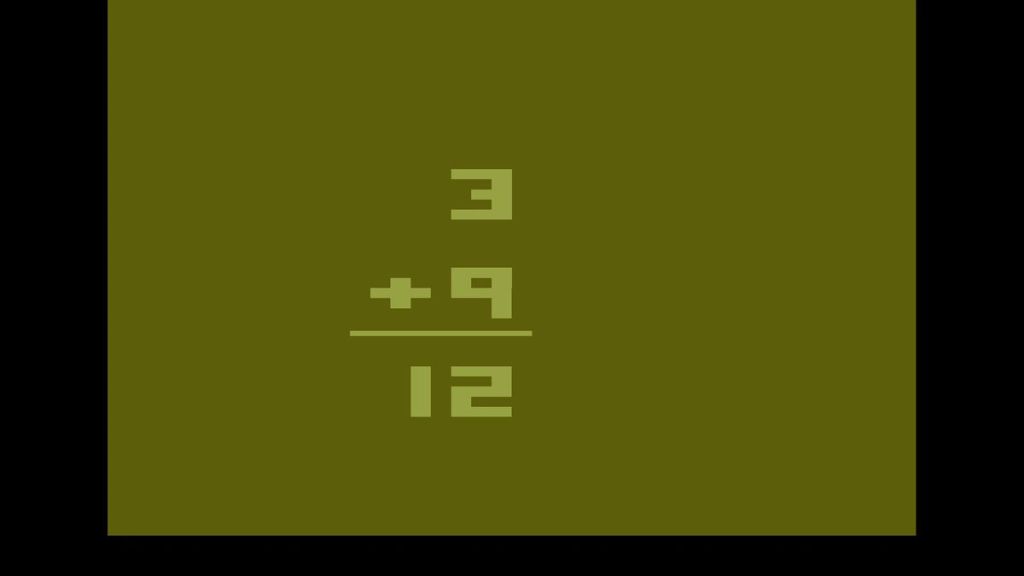
But before doing so, I really want to stress that this game is indeed, basic math. The title is what it says it is. To think that it is going to be a huge source of entertainment would be a mistake.
In it, you do addition, subtraction, multiplication, and division problems. At the beginning of the game you choose what type of problem you want to solve and then choose your answer by pressing up or down on the joystick. You can also move to the left or right to change your place value. Once you have an answer, press the button and the game will tell you if you got it correct with a positive tune. If you entered something wrong, the answer will change to show the correct solution and you’ll go on to the next question. After answering 10 of these the game will tell you how many you got correct.
One thing about the game that I like is that there are two different modes of each type of problem. In the first, you can manually enter the number you want on the top. This means that if you need practice with your multiplication tables for 7’s then this game will help you go through them pretty easily. Plus, they won’t be in exact order so that will make them a bit more challenging as you learn them. In the second mode the game chooses both the top and bottom number, which makes things more diverse and challenging for little ones.
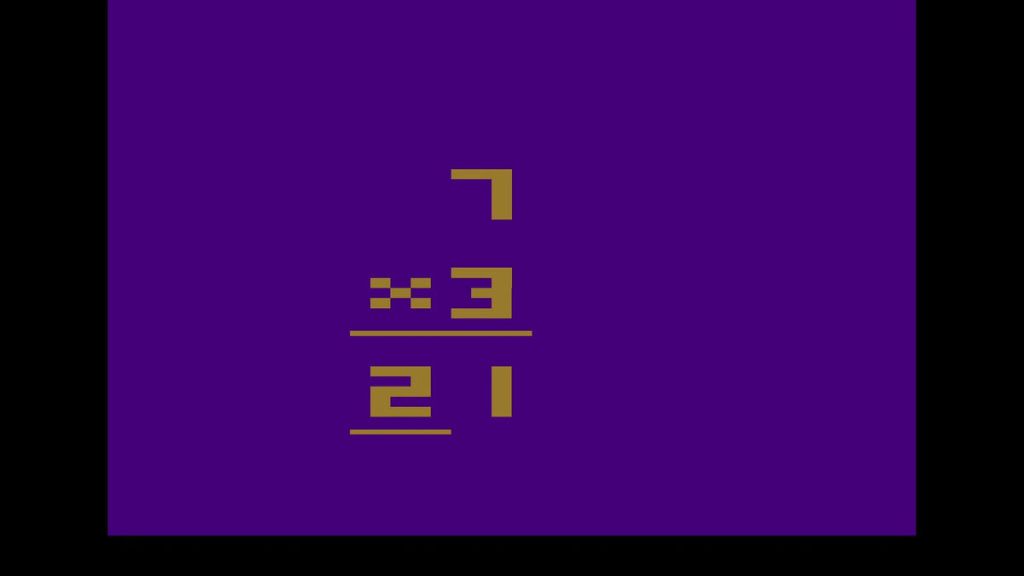
You can also change the difficulty of the game so the majority of the problems include numbers with two place values. Unfortunately, some of these can be rather challenging, especially when doing two digit multiplication. Additionally, you can use an optional in-game timer to add more pressure as well. Note: There is no way to have the game give you a mix of all the different math problems at once.
Areas of Concern
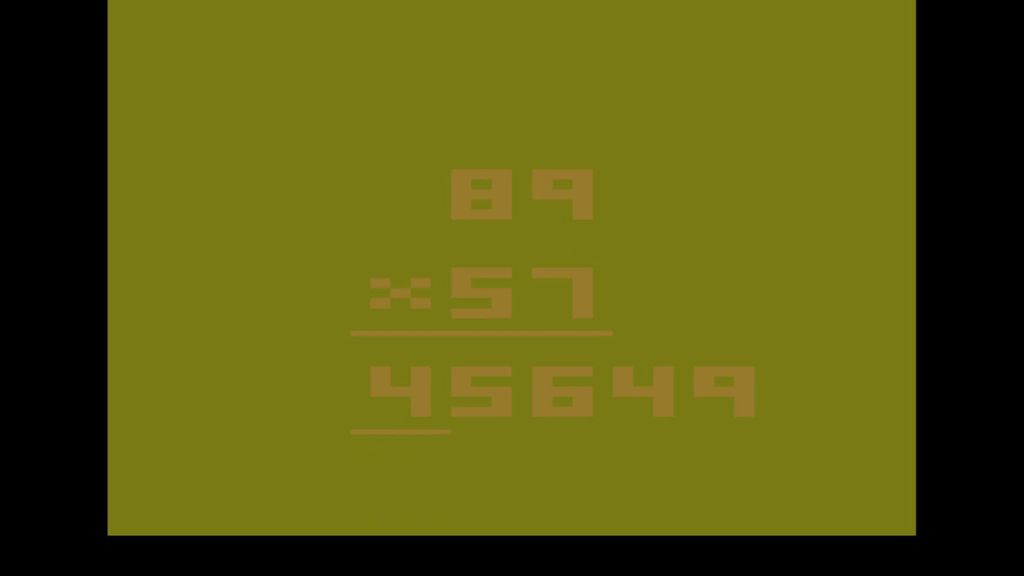
While Basic Math is good for being a source of both simple math problems, there are some irritations with it. The most pressing is how multiplication is handled at the higher difficulty. At that level a lot of the questions have 2-digit numbers on both top and bottom. That means that you could get questions such as 95 x 43. In of itself, this isn’t a serious issue.
The problem is that Basic Math doesn’t give you much space to do your math work. The only area where you can enter numbers is on the 6 fields near the bottom of the screen. If your temporary work cannot fit in those spaces, then you should do the work on paper instead. Also, being quick is necessary; if you just let the screen stand still too long then the game will reset, thus erasing all your progress.
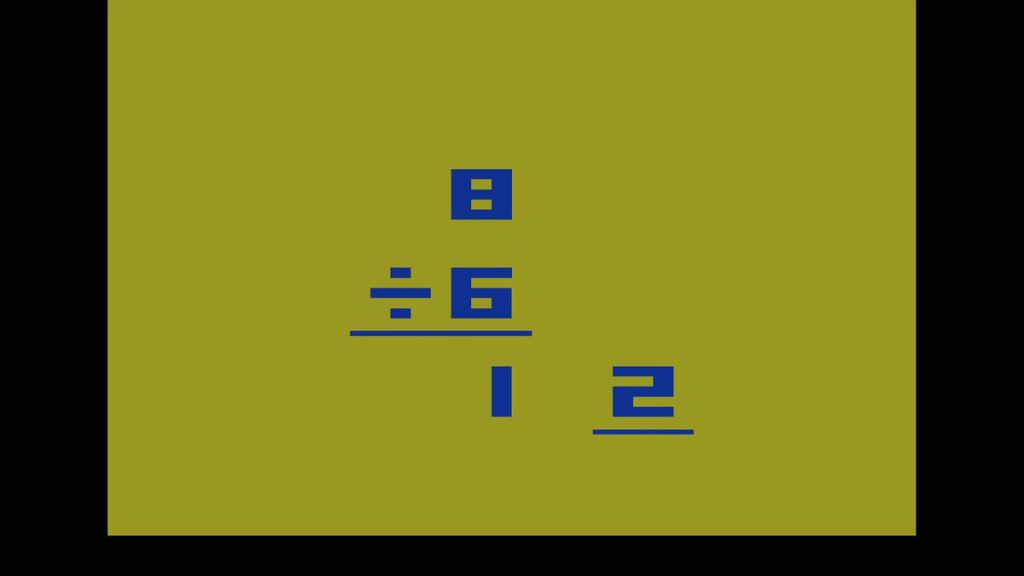
In the area of division problems there’s another oddity. When doing division, the game doesn’t allow you to use decimal points. This means that if you have a problem like 17 / 5, the answer is not 3.4. In fact, Basic Math doesn’t have decimal points. Rather, the answer is 3 and a remainder of 2. You have to keep this in mind while playing. An answer like 2.25 that you could use in real life may need to be entered as “2 1” in Basic Math.
Graphics
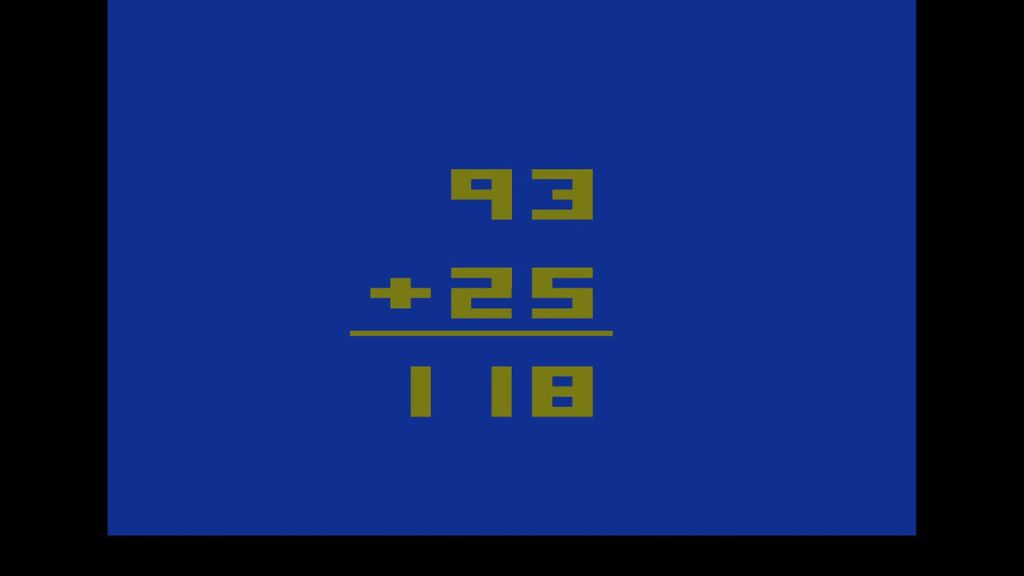
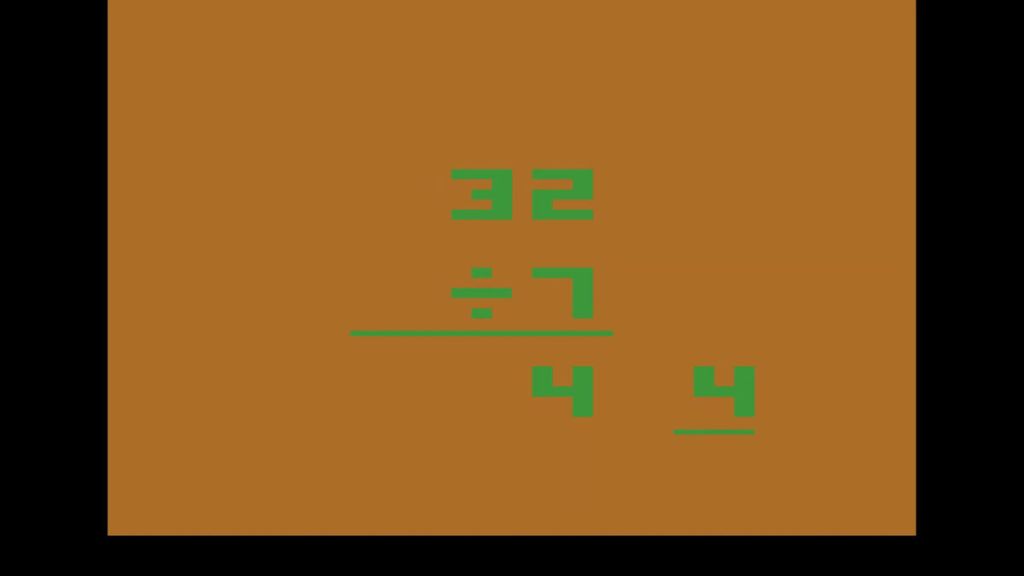
This is probably the easiest part of the game to discuss. Basic Math has no graphics. It just has low resolution math problems for you to solve. There are no additional images anywhere. The game doesn’t even have a crude check mark after entering a correct answer.
It does have some very garish text and background combinations based on the game mode you pick, though!
Sound Effects
Unlike the graphics, there are actual sound effects in Basic Math. Essentially, depending on whether you get a problem correct or not causes a short tune to play. As is typical of the Atari 2600 hardware, these are very primitive and sound rather shrill. I don’t like how they sound, but I don’t hate them either.
My favorite part about the sound design is that when you move up or down when choosing your numbers a tone changes in pitch. I like this and it caused me to cycle through the numbers just to hear it.
Summary
As I played this game and learned more about it, specifically with the difficulty settings and the timer, I grew to actually appreciate it. Sure, it’s super primitive and looks and sounds bad, but I think there’s one thing that we can’t forget. It’s a game called “Basic Math,” and its job is to give you basic math problems.
It does this successfully.
Because of that, I think it deserves at least a mixed rating. Still, hopefully after kids play this for 10-15 minutes, parents would let them play Combat (Wikipedia) instead as a reward.
Other Atari titles I’ve reviewed previously include Air-Sea Battle, Breakout, and PONG.
Review Overview

Summary: This isn’t much of a game, but it does what it says it is. It gives players a series of basic math problems along with a few options, so I am giving it a positive rating.
Title: Basic Math (Price Charting)
Genre: Education
Year Released: 1977
Developer: Atari
Available On: Atari 2600, Nintendo Switch 1 and 2, Xbox One and Xbox Series X|S, PlayStation 4 and 5, and Steam through Atari 50: The Anniversary Celebration as a hidden game
Price Paid: $0.19, or $20 for a game bundle
Remember, we can have different opinions about the games we play. If you like something more (or less) than I do, both of our perspectives are valid.
 Cheap Retro Gaming
Leave a comment