

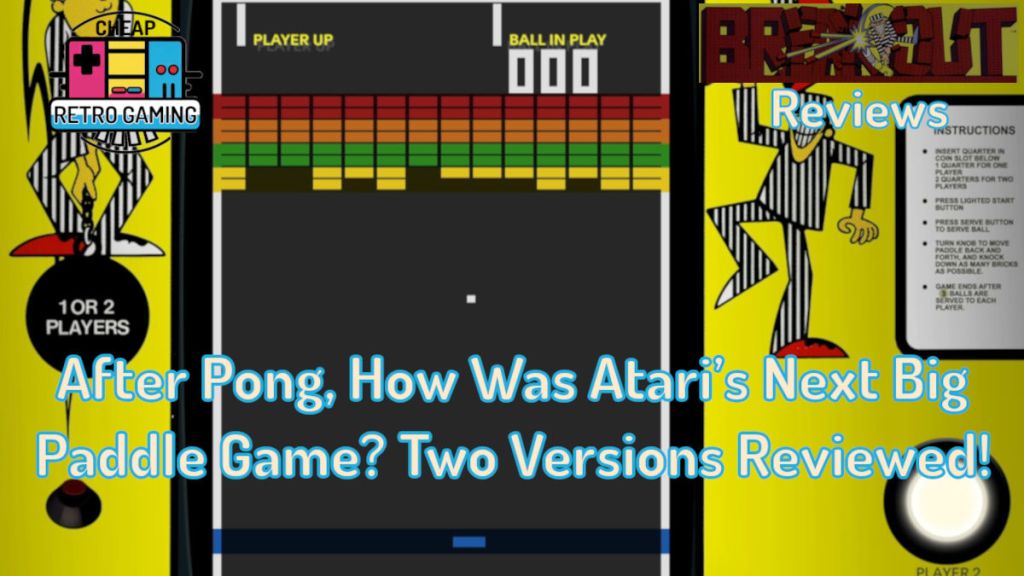
My last Atari review was for Pong, the first financially successful video game. I played it on Atari 50: The Anniversary Celebration. After its release, the company was far from done with ball and paddle games. One of their next big releases was Breakout, which is the second Atari game I have available.
In Contrast to Pong
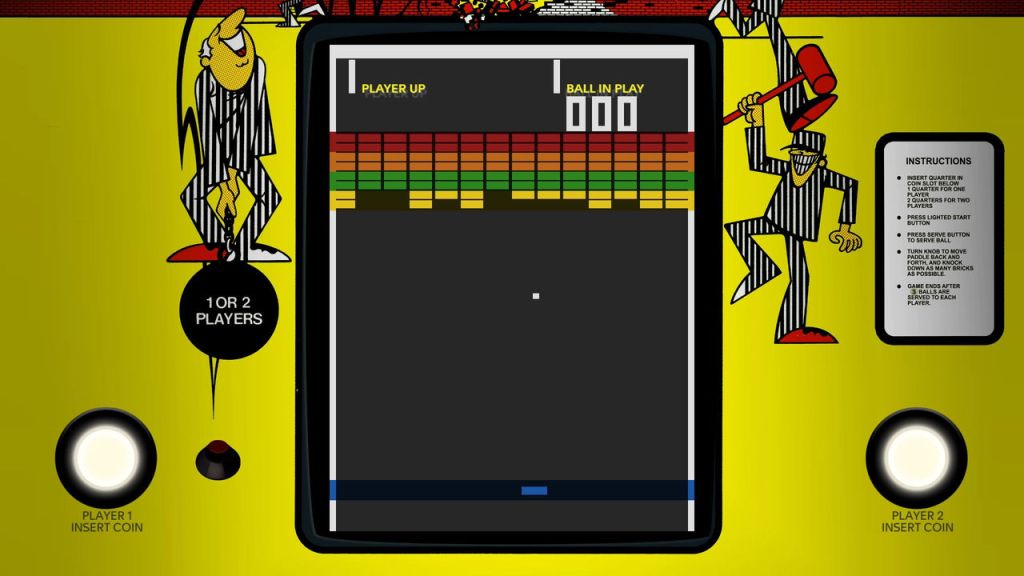
Like the previous game, it is a ball and paddle title; however, Breakout is different in a number of ways. Some of these include,
- It is one player,
- The screen is flipped so you are shooting the balls upward,
- It has more color on screen,
- It speeds up as you break bricks,
- And it has a faster gameplay loop.
In the case of Pong, that title had you score 15 points to win the game, but matches could be really drawn out if you had two skilled players competing against each other. In contrast to that, Breakout only has three or five balls be served to you per game. Once all of them have gone past your paddle, it’s game over!
Gameplay

As I shared earlier, instead of competing with another player, here you are faced with multicolored rows of bricks that you need to break with your ball. Also, the orientation of the game is flipped where your paddle is on the bottom of the screen and you bounce the ball back up toward the top. Your paddle moves from left to right instead of up and down like in Pong. You earn more points as you hit blocks that are higher up the screen.
In regard to ball speed, it begins at a rather slow speed, but quickly changes after hitting four bricks. I think the game runs at a good clip at this point, but apparently the developers had other ideas! The ball speed increases again when you hit 12 bricks, too. I know that in the Atari 2600 version your paddle shrinks when you are going at this speed too, I am unsure if the arcade version exhibits the same behavior.
Because of the increased ball speed I consider Breakout to be more difficult than Pong, and it feels like you really need to “get good” to be successful in this title. It also seems to have a greater focus on score chasing since the game doesn’t stop at 15 points.
Sound Effects

Unfortunately, one area where there isn’t much advancement over Pong is in the area of sound effects. Breakout was released four years after it, but the sound design isn’t much better (if at all). There are sound effects for when your ball breaks a brick, or strikes the wall, but nothing about them are impressive. The sounds do change as you hit blocks that are more near the top of the screen, so there’s that.
Concerns About Boredom

Before closing out this review, I need to stress one more aspect. Like Pong before it, Breakout isn’t exactly a popular title today. Watching balls bounce against walls as you try desperately to smash the last two or three bricks on the screen can be painfully boring! That is, if you can make it that far!
Plus, it’s not fun whenever you start the game and mess up near the beginning of your run. Moreover, the control in this version can be a bit frustrating since you’re not using spinner controls like in the original cabinet. I tended to just tap the D-pad and that was enough for me to feel confident in the game’s control most of the time. I expect that big fans of the arcade game will consider it to be a much worse control scheme though.
Despite all that, Breakout did move gaming forward back in the day through its better graphics, faster gameplay loop, and being able to play the game in single player. I appreciate those improvements, and because of them, I will give the title a modest positive rating.
Review Overview

Summary: A significant gameplay advancement over Pong. The gameplay is faster and more challenging. Unfortunately, control isn’t great and the end game can be boring.
Title: Breakout (Wikipedia)
Genre: Brick Breaking
Year Released: 1976, or 2022 on Steam
Developer: Atari
Played On: Atari 50: The Anniversary Celebration on Steam
Price Paid: $0.19 or $20.00 for a bundle
Remember, we can have different opinions about the games we play. If you like something more (or less) than I do, both of our perspectives are valid.
Breakout Atari 2600 Review
Two years later, Breakout came to the home with a version for the Atari 2600. Of course, this version has a significant downgrade in graphics compared to the arcade game, just as one would expect. But is there a reason to be excited about this port compared to the original arcade game? Read on to find out!
Graphics
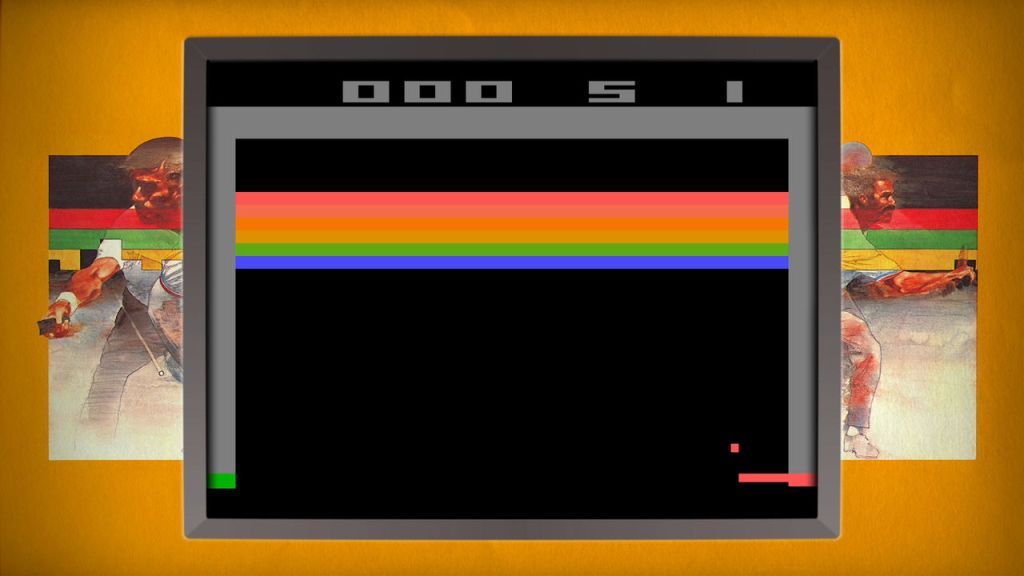
Like I just said, the Atari 2600 release has a big step down in graphics from the arcade game. Where the arcade title had clear, distinctive brick graphics, the Atari 2600 version represents them as solid rows of colors. They look like a rainbow near the top of the screen, actually. Each color appears as one long block across the screen. As you hit them, a block of color from the row is removed. It is almost like you are bashing your ball against a rainbow which is weird, but I became used to it quickly.
Your paddle also looks more simplistic. However, it also seemed a bit wider, which makes the game feel a bit easier to play than the original quarter muncher. If you want more of a challenge you can change the paddle size to be smaller in the options.
Differences in Sound
Beyond the graphics, one of the first things I noticed is that when you break through layers of brick, there are a different sound effects that play as you get higher up the screen. The arcade game had this as well, but I kind of like the Atari 2600’s beeps more because the change in tone is more pronounced. I consider this aspect to be a nice touch! It’s especially noticeable when playing certain gameplay modes.
Gameplay Modes
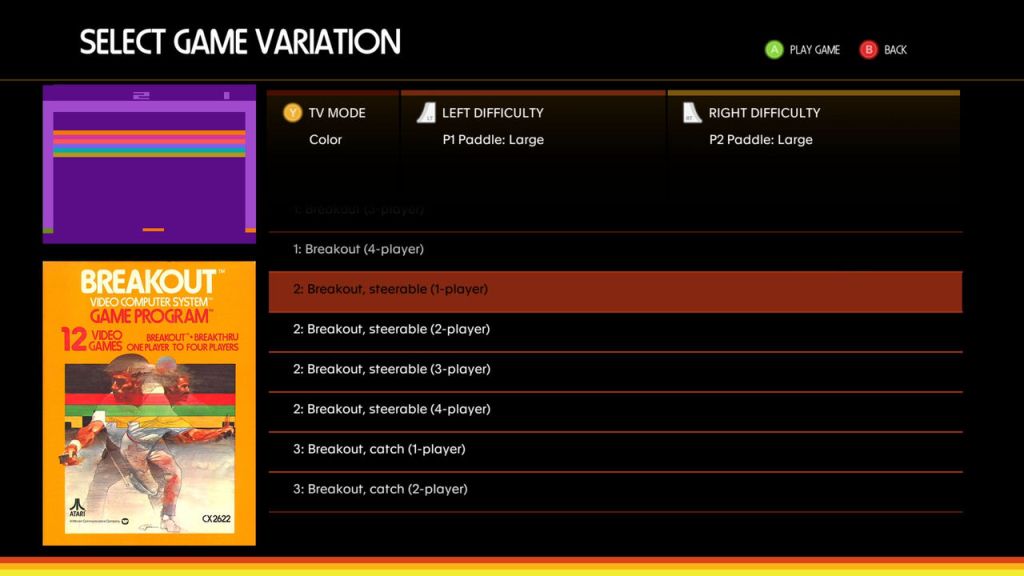
Coming to the meat of the game, I consider the gameplay for this version of Breakout to be superior to the arcade! That stems from the many different game modes available in this version. These are accessible in the menu before you start the game by hitting Y on your controller. After pressing it, you’re presented with a long list of game modes from which to choose.

The first is Steerable. In it, whenever you launch your ball from the paddle you can move the ball to where you want it to go by moving to the left or right. Doing so also moves your paddle at the same time. At first it seems really bizarre! Yet, it may be helpful for the problem of when you need to hit a couple of blocks to finish the level. That’s appreciated! Unfortunately, it often becomes difficult to move the ball precisely where you need it to go since it gets going fast quickly! Still, I’m glad for the mode’s inclusion.
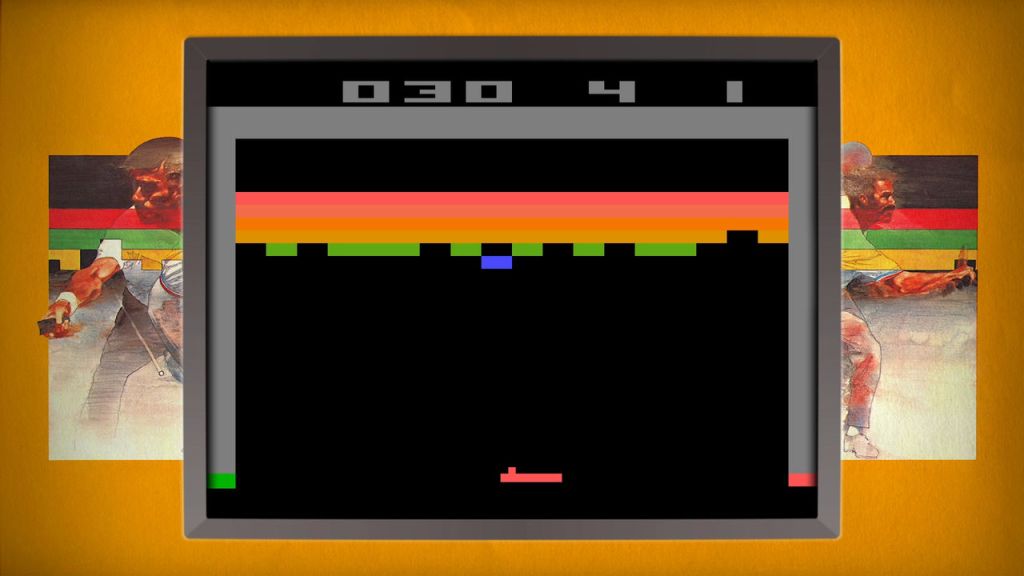
Catch allows you to grab the ball and keep it from bouncing once it touches your paddle. Although there’s no immediate visual indicator for this, if you hold the button down, when the ball hits your paddle it sticks there like it’s attached to glue. While not an amazing mode, some players may like it.

Timed is self-explanatory. You just see how many points you can earn before running out of time. Oddly enough, when you lose a ball you need to press a button to have another ball served to you. If you never hit the button then your score just keeps going up! That’s silly, but also funny to see such a poor oversight early in gaming.

Invisible mode makes it so you cannot see any of the bricks until you hit them. When you do, the rainbow of blocks blink so you can see them for a second. Then they are invisible again. This is the worst mode in my opinion.

Finally, the Atari 2600 cart even includes an alternate game! It’s called Breakthru, and after your ball hits a brick, it does exactly what one would expect. Your ball doesn’t bounce back to you. Rather, it smashes through the bricks, hits the other end of the screen, and comes back down at you at a super-fast speed! This is because you’re breaking through a dozen or more blocks at a time, making it an extremely speedy, difficult game! It’s actually funny to watch, and when I first played it I thought it was hysterically funny!
Because of the way the game is designed, you can earn 100 points in one shot of your ball, and unless you are an expert at the game, it will probably end in less than 15 seconds. It’s great fun to see how quickly you can make the score go up in a such a short period of time. I expect that Breakthru would be an excellent party game as you try and beat each other’s high scores!
Each of these modes can be played with up to 4 alternating players. There are no simultaneous game modes. Still, I think this game could be good for couch co-op competitive play for fans of 1970’s Atari games.
Summary
Compared to the arcade version, there’s a definite hit in resolution and graphics that is unfortunate, but not surprising. Even so, I like the sound effects more, and especially the different game modes. Breakthru is also a great addition! Those aspects, along with the alternating multiplayer options make the game better than the arcade. I recommend it to fans of the brick-breaking genre.
Review Overview
Summary: While graphically inferior, the variety of gameplay modes and alternating multiplayer options makes this more enjoyable than the arcade game! i almost gave it a Very Positive rating!
Title: Breakout (Price Charting)
Genre: Brick Breaking
Year Released: 1978
Developer: Atari
Played On: Atari 50: The Anniversary Celebration on Steam
Price Paid: $0.19 or $20.00 for a bundle.
Remember, we can have different opinions about the games we play. If you like something more (or less) than I do, both of our perspectives are valid.
 Cheap Retro Gaming
Leave a comment